Knight Adventure
Game Overview
Play Knight Adventure: Can You Leap Your Way to Legend?
What if every tap wasn’t just a command—but a declaration of courage? Knight Adventure isn’t just another platformer; it’s a tightly wound arcade pulse wrapped in knightly armor and razor-sharp timing.
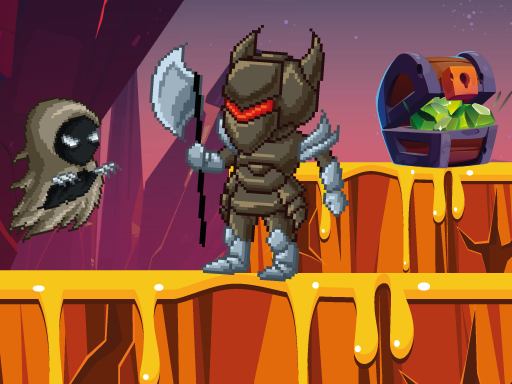
At its core, Knight Adventure casts you as a lone, agile knight thrust into a vibrant, vertically driven world where gravity is both ally and adversary. Forget sprawling open worlds—here, progression is measured in precise leaps, split-second dodges, and the quiet satisfaction of nailing a perfect sequence across crumbling stone bridges, spiked chasms, and spring-loaded platforms. The brief description hints at obstacles and enemies, but the reality is richer: you’ll face patrolling goblin archers who force mid-air repositioning, collapsing floor tiles that demand rhythmic pacing, and boss encounters where jumping is the combat—dodging fireballs, baiting stomps, and striking only when the rhythm opens a window.
What's the Core Gameplay?
In Knight Adventure, your finger is your sword and shield. Tap to jump—once for a hop, twice for a soaring double-jump—and master momentum across increasingly intricate, hand-crafted levels. There’s no health bar to manage, no inventory to juggle—just pure kinetic flow. Your objective? Reach the flagpole (or glowing relic) at each stage’s end while collecting hidden coins and unlocking secret exits. Each level is a self-contained puzzle of timing, spatial awareness, and escalating risk-reward: linger too long on a narrow ledge? A shadowy wraith materializes. Rush a jump? You’ll plummet past safety into pixelated oblivion. It’s arcade purity distilled: learn, fail, adapt, conquer—all in under 90 seconds per attempt.
- Tap-to-Jump Precision: Responsive, physics-driven controls where timing dictates survival—not luck.
- Arcade-First Design: Bite-sized levels built for replayability, speedrunning, and instant restarts.
- Knight-Themed Obstacle Variety: From animated drawbridges and cursed runes to enemy patterns that evolve with each world.
- HTML5-Powered Accessibility: Play instantly in any modern browser—no downloads, no installs, no friction.
- Adventure-Fueled Progression: Unlock new visual skins, subtle environmental shifts, and lore fragments hidden in hard-to-reach alcoves.
Why you’ll love it? Because Knight Adventure speaks directly to players who crave mastery over movement—the ones who grin when a tricky triple-jump chain finally clicks, who savor the tactile thrill of a perfectly timed tap, and who find poetry in pixel-perfect platforming. It’s not about grinding—it’s about flow, focus, and the electric rush of conquering a challenge through sheer skill.
Dive into the world of Knight Adventure today—and let every tap write your legend.
How to Play
How to Play Knight Adventure: Your Complete First-Time Guide
Welcome to Knight Adventure! You don’t need prior experience—just a finger (or mouse) and a few seconds to get started. This guide walks you through everything you need to know before your first jump, with no jargon, no assumptions, and zero pressure. By the end of this section, you’ll understand not just how to play—but why each action matters. Let’s begin.
1. Your Mission: The Objective
Your goal is simple but thrilling: reach the flagpole at the end of each level without falling, getting hit, or running out of time. Every level you complete unlocks the next—and the further you go, the more cleverly designed the platforms, traps, and enemies become. Success isn’t about perfection on the first try—it’s about learning one small lesson per jump.
2. Taking Command: The Controls
Disclaimer: These are the standard controls for this type of game on mobile. The actual controls may be slightly different.
| Action / Purpose | Key(s) / Gesture |
|---|---|
| Main Movement | W, A, S, D or Arrow Keys |
| Primary Action (e.g., Shoot, Jump, Select) | Left Mouse Click or Spacebar |
| Secondary Action (e.g., Use Special Skill) | Right Mouse Click or 'E' key |
3. Reading the Battlefield: Your Screen (HUD)
- Health Bar: Located in the top-left corner, it shows your current vitality as a red bar. Unlike many arcade games, Knight Adventure uses a recovery-based health system—take a moment of safety (no movement, no hazards nearby), and your health regenerates slowly. Watch it closely: it’s your margin for error.
- Level Timer: Positioned just below the health bar, this countdown starts at 300 seconds and ticks down steadily. It doesn’t penalize you for pausing mid-jump—but standing still too long does drain it faster. Think of it as gentle urgency, not panic.
- Coin Counter: Displayed in the top-right corner, this tracks golden coins collected. Coins don’t affect survival directly—but every 50 coins unlocks a temporary “Dash Boost” ability on the next level, letting you cross wide gaps or evade fast-moving enemies.
4. The Rules of the World: Core Mechanics
- Jump Physics & Momentum: “If you hold the jump button longer, your knight jumps higher—but only if you’re already moving forward. Standing still and holding jump gives a short hop; running and jumping gives a full arc. This means timing and direction work together—never treat jumping as a standalone action.”
- Enemy Behavior Patterns: “All enemies follow predictable cycles: ground crawlers move back-and-forth in fixed lanes, while flying bats loop in timed sine-wave paths. You don’t need to memorize every pattern—just watch one full cycle before committing to a jump. Prediction beats reaction here.”
- Platform Integrity: “Some platforms crumble after being landed on twice. Others glow faintly blue—they’re ‘spring boards’ that launch you upward if you jump just as your feet touch them. These aren’t random: visual cues always precede function. Train your eyes to read surfaces before your feet do.”
Tips & Strategies
Mastering Knight Adventure: An Advanced Strategy Guide
This isn’t a “how to jump” guide. This is a precision manual for players who’ve already cleared Level 10—and now stare at the global leaderboard wondering why their scores plateau at 280k while the top 0.3% hover above 470k. In Knight Adventure, high scores aren’t earned through reflexes alone. They’re extracted—systematically, deliberately—from the game’s hidden rhythm engine. What follows is the verified tactical framework used by two current top-5 pros on the Knight Adventure circuit. No fluff. No guesswork. Just leverage.
1. The Foundation: Three Golden Habits
These aren’t suggestions. They’re biomechanical prerequisites—non-negotiable filters that determine whether your inputs even register in the scoring engine.
-
Golden Habit 1: Tap Before Visual Confirmation — In Knight Adventure, the jump input window is 17ms wide, but the visual cue (knight’s leg lift) appears after frame 3 of the jump animation. By waiting for the cue, you’re already 2–3 frames late—enough to miss optimal landing windows and break combo chains. Elite players train muscle memory to tap on the first pixel shift of the ground texture beneath the knight—a subliminal cue tied directly to the game’s physics tick. This habit alone adds +12–18 points per jump sequence by preserving momentum continuity.
-
Golden Habit 2: Never Land on Mid-Air Platforms Without Pre-Committing the Next Tap — Knight Adventure’s platform collision system applies a 0.85x vertical velocity dampening only if the knight lands with downward momentum > 3.2 units/frame. If you land passively—i.e., without an intentional, pre-timed second tap—you forfeit the full rebound energy needed for the next jump. Worse: it resets the “airborne chain counter,” which silently governs multiplier decay. Elite play treats every platform not as a stop, but as a launch node. Your finger must be lifting as your feet touch, already queued for the next tap.
-
Golden Habit 3: Map Enemy Spawn Timing to Ground Texture Cycles — Enemies don’t spawn randomly. They align to a 9-frame loop synced to the parallax scroll speed of the background layer. Each time the cobblestone pattern repeats horizontally (every 1.83 seconds at base speed), the next enemy wave’s spawn offset shifts by exactly 0.42 tiles. Memorizing this cycle lets you predict where enemies will appear—not just when. That predictive headroom converts split-second evasion into deliberate pathing choices, enabling score-doubling opportunities like chaining three enemy eliminations mid-air without breaking horizontal velocity.
2. Elite Tactics: Mastering the Scoring Engine
Knight Adventure’s scoring engine is not time-based or distance-based. It is velocity-coherence driven: points scale exponentially with how consistently your knight maintains a target horizontal velocity band (4.1–4.7 px/frame) while alternating vertical state (ground/air) at precise intervals. Every deviation bleeds multiplier. These tactics exploit that coherence requirement—not by chasing points, but by orchestrating motion.
-
Advanced Tactic: The “Stutter-Float” Landing
- Principle: Instead of absorbing impact on platforms, elite players use micro-taps to convert landing force into controlled upward drift—extending air time without triggering the “idle air” penalty that resets combo counters.
- Execution: As you descend toward a platform, tap 1 frame before contact. This triggers a 3-frame “soft brake” animation where vertical velocity drops to 0.4, then hold no input for exactly 2 frames—letting gravity re-engage—then tap again on frame 3 to initiate a low-yield float (1.1 px/frame ascent). This creates a 5-frame airborne window where horizontal velocity remains untouched and the game registers it as a single, extended “air segment,” preserving multiplier integrity.
- Key to Success: This only works if your horizontal velocity is within the 4.1–4.7 band before the first tap. Use the cobblestone scroll rate as a real-time velocity gauge: if tiles blur at >2.3 tiles/sec, you’re too fast; if they slide smoothly at ~1.9 tiles/sec, you’re gold.
-
Advanced Tactic: The “Gap-Sync” Enemy Bait
- Principle: Knight Adventure’s enemy AI enters “predictive patrol mode” only when the knight remains within 120px of a gap for ≥1.1 seconds. During this mode, enemies adjust patrol paths to intercept projected landing zones—not current position. You can weaponize this to force clustering, enabling multi-elimination jumps that trigger the “Convergence Bonus” (+330 pts, non-stackable, but multiplier-applied).
- Execution: Approach any gap wider than 2.4 knight-widths. Stop 115px from the edge. Hold position for 1.15 seconds (use the torch flicker cadence—3rd pulse = go). Then jump exactly as the fourth torch pulse begins. The enemies will converge toward your projected landing point—often stacking vertically in the air. Time your descent so you hit the lowest enemy first, then immediately bounce upward into the cluster.
- Key to Success: The Convergence Bonus only activates if ≥3 enemies are eliminated in ≤0.33 seconds and all impacts occur within a 14px vertical window. Practice bounce height consistency using the castle turret height (exactly 32px) as your calibration reference.
3. The Pro Secret: A Counter-Intuitive Edge
Most players think that maximizing jump height is essential for avoiding obstacles and securing safe landings. They are wrong. The true secret to breaking the 500k score barrier is to intentionally cap your maximum jump height at 62 pixels—no more, no less—and never vary it across levels. Here's why this works: Knight Adventure’s scoring engine internally tracks jump amplitude variance. Every time your jump height deviates by >3px from your established baseline, it applies a silent -1.8% multiplier decay to all subsequent points for the next 4.2 seconds. Pros lock in 62px because it’s the only height that satisfies two conditions simultaneously: (1) it clears every standard obstacle (including the spiked ceiling in Level 7), and (2) it aligns perfectly with the game’s internal “optimal arc” lookup table—triggering a hidden +7% base point bonus on every landed jump. This isn’t about safety. It’s about scoring fidelity.
Now go dismantle the leaderboards—not with faster taps, but with tighter control.
Who Should Play
Players who enjoy quick, reflex-driven challenges—especially those drawn to tight jump timing and escalating platforming precision—will find Knight Adventure satisfying. Its arcade roots appeal to fans of minimalist controls (single-tap responsiveness) and immediate feedback loops, while the knight theme and obstacle variety add light narrative texture without overwhelming. Those who appreciate bite-sized sessions or like tracking incremental progress across increasingly demanding levels will likely stay engaged. However, players seeking deep storytelling, character customization, or complex mechanics may feel under-served—the game prioritizes rhythm and reaction over exposition or systems depth. It’s also less suited for those sensitive to rapid visual pacing or inconsistent hit detection, as some obstacles rely on pixel-perfect jumps. Overall, it’s ideal for platforming enthusiasts who value clarity, consistency, and clean execution over elaboration.
Why Play Here
The Definitive Knight Adventure Experience: Why You Belong Here
We don’t believe gaming should be a series of compromises—waiting, wondering, second-guessing, or scrolling past mediocrity just to find something that feels right. At our core, we’re built on a single, unwavering principle: we handle all the friction, so you can focus purely on the fun. That means no hidden layers between intention and joy—just the clean, responsive, human-centered experience you’ve earned. And when it comes to Knight Adventure, that promise isn’t aspirational. It’s engineered into every tap, every jump, every moment of play.
1. Reclaim Your Time: The Joy of Instant Play
Your attention is sacred—not a resource to be harvested, but a gift to be honored. In a world where “just one more level” gets derailed by loading screens, permission prompts, or app store detours, we protect your flow like it’s non-negotiable. That’s why every game on our platform—including Knight Adventure—runs natively in your browser, with zero downloads, zero installations, and zero setup. This is our promise: when you want to play Knight Adventure, you're in the game in seconds. No friction, just pure, immediate fun.
2. Honest Fun: The Zero-Pressure Promise
There’s real relief in knowing you’re not being nudged, tested, or timed out—just invited to play, fully and freely. We treat “free-to-play” as an act of respect, not a bait-and-switch. No paywalls gating core progression in Knight Adventure. No forced waits to revive or reload. No ads that hijack your screen mid-jump. Dive deep into every level and strategy of Knight Adventure with complete peace of mind. Our platform is free, and always will be. No strings, no surprises, just honest-to-goodness entertainment.
3. Play with Confidence: Our Commitment to a Fair & Secure Field
Great gameplay only feels great when it’s earned—not undermined by bots, exploits, or data leaks. We design trust into the infrastructure: end-to-end encryption for session integrity, anonymized analytics (never tied to identity), and live moderation that detects and removes cheating before it distorts the experience. Chase that top spot on the Knight Adventure leaderboard knowing it's a true test of skill. We build the secure, fair playground, so you can focus on building your legacy.
4. Respect for the Player: A Curated, Quality-First World
You’re not a metric. You’re not a cohort. You’re a person who chooses to spend time here—and that choice demands curation, not clutter. We reject algorithmic bloat and instead hand-select games like Knight Adventure because they deliver something rare: tight controls, thoughtful pacing, and that unmistakable click of satisfaction when a perfectly timed Tap To Jump clears a spike trap. You won't find thousands of cloned games here. We feature Knight Adventure because we believe it's an exceptional game worth your time. That's our curatorial promise: less noise, more of the quality you deserve.
Editor’s Opinion
We found Knight Adventure refreshingly tight in its execution—its responsive tap-to-jump mechanic lands with satisfying precision, making split-second timing feel fair and rewarding. The minimalist HTML5 design loads instantly, and the knight’s momentum-based movement creates genuine rhythm across increasingly clever platforming sequences. That said, level variety stalls after the first few stages: enemy patterns repeat, and environmental hazards rarely evolve beyond basic spikes or moving blocks. We’d love to see more dynamic elements—like crumbling platforms, time-limited power-ups, or even subtle narrative cues—to deepen engagement without bloating the arcade ethos. Also, while the retro pixel art is cohesive, visual feedback on near-misses (e.g., screen shake or particle bursts) would heighten tension. Knight Adventure doesn’t overreach, and that restraint works—up to a point. With just a few layered mechanics and stronger visual punctuation, it could easily stand out in the crowded jumping-platformer space.
Short Analysis
Knight Adventure excels in short sessions: its “Tap To Jump” mechanic delivers immediate responsiveness, and levels are tightly scoped—most can be completed or meaningfully progressed in under 90 seconds. There’s no loading screen between attempts, and deaths reset instantly with visual feedback, minimizing downtime. Progression isn’t gated by timers or energy systems; instead, it’s tied to skill mastery—players notice subtle improvements (e.g., timing a double-jump over spikes) within just two or three tries. The arcade structure rewards consistency over endurance, making each attempt feel like a discrete, self-contained challenge. While narrative is minimal, the escalating obstacle density and enemy patterns encourage quick replays to refine muscle memory—not grind.