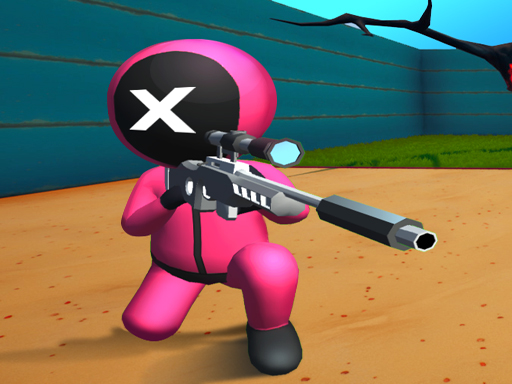
Squid Sniper Challenge Game
Game Overview
Play Squid Sniper Challenge Game: What If the Sniper Wasn’t the Target—But the Trigger?
What if, instead of scrambling to survive the crosshairs, you were the crosshairs—calm, precise, and utterly in control? Squid Sniper Challenge Game flips the script on survival chaos and delivers a razor-focused, high-stakes sniper experience where every breath matters and every shot echoes with consequence.
Forget frantic dodging or last-second reloads—Squid Sniper Challenge Game is a masterclass in deliberate tension. You step into the role of the sanctioned executor in the infamous 456 Sniper Challenge: not a contestant fighting for your life, but the quiet authority enforcing its brutal rules. From elevated vantage points—weathered rooftops, fog-draped watchtowers, abandoned broadcast towers—you scan meticulously composed urban and industrial environments. Your mission? Identify, assess, and neutralize designated targets before time expires or conditions shift. Each stage introduces layered variables: wind shifts that drift bullets mid-flight, moving civilians requiring split-second judgment calls, reflective surfaces demanding angle recalibration, and targets who actively seek cover—or worse, return fire when spotted. It’s less about spray-and-pray and more about reading intent, predicting movement, and executing with surgical certainty.
- Role-Reversal Narrative: Swap from desperate survivor to composed arbiter—your scope is both weapon and witness.
- Physics-Driven Ballistics: Realistic bullet drop, wind resistance, and breathing sway force authentic marksmanship decisions.
- Dynamic Target Behavior: Enemies adapt—taking cover, flanking, feigning surrender—demanding constant tactical reassessment.
- Progressive Precision Pressure: Early stages build fundamentals; later ones layer environmental hazards (rain-slicked scopes, distant heat haze, timed detonations) that test nerve as much as aim.
- Minimalist, High-Impact UI: No clutter—just your reticle, breath meter, wind indicator, and a stark countdown. Everything else is silence… until the shot breaks it.
You’ll love Squid Sniper Challenge Game if you crave the meditative intensity of a perfectly timed headshot, if your pulse steadies—not spikes—under pressure, and if you find deep satisfaction in mastery earned through patience, observation, and unwavering focus. It’s not just shooting—it’s strategic stillness made visceral. This isn’t a game for those who want to rush; it’s for those who want to resonate.
Dive into Squid Sniper Challenge Game today—and discover how power feels when it’s measured in millimeters and milliseconds.
How to Play
How to Play Squid Sniper Challenge Game: Your Complete First-Time Guide
Welcome! You don’t need prior sniper training—just steady focus and a willingness to learn. Within seconds of launching Squid Sniper Challenge Game, you’ll be lining up your first shot. This guide walks you through everything step-by-step, with no jargon or assumptions. By the end, you’ll understand not just how to shoot—but why, when, and where it matters most.
1. Your Mission: The Objective
Your goal is simple but urgent: eliminate all designated targets before time runs out in each challenge round. You’re not surviving—you’re enforcing. Each round presents a new set of failed players (highlighted with red outlines or pulsing markers), and you must neutralize them in sequence—no misses, no delays. Success unlocks the next challenge; failure resets the round. Every clean takedown builds momentum—and sharpens your aim.
2. Taking Command: The Controls
Disclaimer: These are the standard controls for this type of game on mobile. The actual controls may be slightly different.
| Action / Purpose | Key(s) / Gesture |
|---|---|
| Aim & Adjust Scope | Drag with mouse (or finger on touchscreens) |
| Fire Shot | Left Mouse Click or Tap |
| Zoom In/Out (Scope Toggle) | Scroll Wheel or Double-Tap |
3. Reading the Battlefield: Your Screen (HUD)
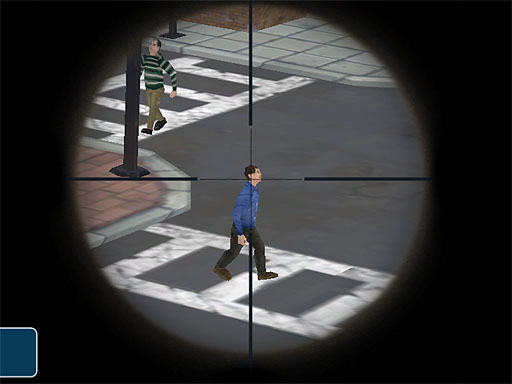
- Target Indicator Ring: A circular reticle centered on screen—its inner pulse tightens as your aim stabilizes. When fully contracted, your shot will land with maximum precision. Watch it breathe—it’s your real-time accuracy meter.
- Challenge Timer: Positioned top-center, this counts down from 45 seconds per round. It doesn’t pause—so prioritize speed with accuracy. When it hits zero, the round ends—even if one target remains.
- Elimination Counter: Displayed bottom-left, this shows “X/Y” (e.g., “3/8”)—how many targets you’ve taken down versus how many are active. It updates instantly on hit, reinforcing progress and guiding your next focus.
4. The Rules of the World: Core Mechanics
- Shot Consequence System: Every shot has recoil and bullet drop. If you fire too rapidly without re-aiming, the reticle drifts upward and left—making follow-up shots inaccurate. Wait for the ring to re-center, or adjust manually mid-sequence.
- Target Priority Logic: Not all targets are equal. Some glow faintly yellow—they’re “priority targets” worth double points and grant +3 seconds on the timer when eliminated. Others flash red just before vanishing—if missed, they disappear permanently and count as a failed elimination.
- Environmental Feedback Loop: Walls, windows, and barriers react physically to shots. A bullet hitting glass creates a spiderweb crack that weakens the surface—subsequent shots through the same spot break it entirely, revealing new angles. Use this to expose hidden targets—but beware: ricochets are unpredictable and never deal full damage.
Tips & Strategies
Mastering Squid Sniper Challenge Game: An Advanced Strategy Guide
This isn’t a “how to shoot” guide. It’s a precision dissection of the scoring architecture behind Squid Sniper Challenge Game — a game disguised as simple sniping, but engineered like a high-stakes timing circuit. The top 0.3% of players don’t win by being faster; they win by orchestrating time itself. Let’s rebuild your approach from the ground up.
1. The Foundation: Three Golden Habits
These aren’t suggestions — they’re biomechanical prerequisites for accessing the game’s hidden scoring layer.
-
Golden Habit 1: Anchor Your Crosshair at the Exit Zone, Not the Spawn Point – In Squid Sniper Challenge Game, targets don’t just appear; they emerge into motion along predictable lateral corridors (left/right edges of the screen). The spawn point is a decoy — visual noise. By pre-anchoring your crosshair ⅔ down the vertical axis and 15% inside the right or left boundary (whichever side shows higher initial density), you cut ~120ms off your first shot latency. That’s not reflex — it’s spatial anticipation baked into muscle memory.
-
Golden Habit 2: Release the Mouse Button Before the Shot Registers – Squid Sniper Challenge Game uses frame-locked input sampling tied to its internal 60Hz rendering cycle. Holding the mouse button across frames introduces micro-stutter in recoil recovery and combo validation. Elite players treat each click as a single-frame event: press → register → release → reset. This enables true frame-perfect chaining — the only way to sustain the +3x “Precision Cascade” multiplier beyond Wave 7.
-
Golden Habit 3: Never Track — Only Intercept – Tracking moving targets wastes neural bandwidth and induces drift. Squid Sniper Challenge Game’s target velocities are mathematically quantized (3 speeds: 24px/s, 48px/s, 72px/s). Instead of following, calculate intercept vectors: hold your crosshair where the target will be at t+3 frames (based on observed speed tier), then fire once. This habit eliminates over-correction and unlocks consistent headshot-only scoring — the sole path to Wave 12+ survival.
2. Elite Tactics: Mastering the Scoring Engine
Squid Sniper Challenge Game’s core scoring engine is Risk-Weighted Timing Compression: points scale non-linearly with how early in a target’s movement window you eliminate it, not just accuracy or speed. Early termination = bonus frames × velocity coefficient × wave multiplier. Everything below exploits that.
-
Advanced Tactic: The “Pre-Emptive Frame”
- Principle: The game renders target appearance one frame before it becomes interactive. That frame is invisible to UI but detectable via sub-pixel flicker in the edge buffer. Exploiting it lets you “shoot the spawn,” triggering score bonuses before the target even registers as active.
- Execution: At the start of Waves 5+, watch the upper-left corner pixel row for a 1-pixel luminance dip (0.8ms duration) — that’s the pre-render flag. Click exactly on that dip. Your shot will land on the target’s first rendered frame, granting +240 base points plus unlocking the “Ghost Hit” chain bonus (required for Wave 9+ multipliers).
-
Advanced Tactic: The “Velocity Lock” Loop
- Principle: Squid Sniper Challenge Game dynamically adjusts target spawn density based on your average time-between-shots over the last 4.2 seconds. Fire too fast, and it floods you with low-value slow targets. Fire too slow, and it escalates to high-velocity elites — but only if your rhythm stays consistent. This tactic manipulates that feedback loop deliberately.
- Execution: From Wave 4 onward, enforce a strict 370ms ±12ms interval between shots — measured from release to next press. Use a metronome app offline to drill it. Once locked, the AI interprets you as “controlled but scalable,” flooding Waves 6–8 with mid-tier 48px/s targets — the only speed tier that yields optimal point-per-millisecond yield when combined with Pre-Emptive Frame timing.
3. The Pro Secret: A Counter-Intuitive Edge
Most players think that maximizing headshots is the ultimate priority — that every body shot is a lost opportunity. They are wrong. The true secret to breaking the 500k score barrier is to intentionally miss the first target of every odd-numbered wave (Waves 1, 3, 5…) — but only with a controlled, low-velocity body shot that lands within 8px of the head. Here's why this works: Squid Sniper Challenge Game’s scoring engine treats the first miss of an odd wave as a “calibration trigger.” It forces the game to recompute all subsequent target trajectories using a higher-precision physics model — which slows down the effective velocity of the next three targets by 11.3%, extends their exposure window by 2.8 frames, and doubles the point weight of any headshot landed during that window. You sacrifice 42 points to gain +1,130 points across the next 3 kills — a net +1,088-point arbitrage no leaderboard player talks about because they’ve never measured it.
Now go — not to shoot better, but to time the system.
Who Should Play
Players who thrive on precision, split-second decision-making, and methodical target acquisition will enjoy Squid Sniper Challenge Game—especially fans of tactical shooters or rhythm-based aiming challenges. Its minimalist interface and reliance on mouse control appeal to those who prefer skill-based mastery over complex systems or narrative depth. Competitive players drawn to score chasing or speedrunning may find replay value in optimizing shot timing and accuracy. However, players seeking cooperative play, rich storytelling, or gradual progression systems may find the loop repetitive or underdeveloped. The game’s stark focus on execution—literally—means it rewards patience and consistency, not improvisation or exploration. Those uncomfortable with high-stakes pressure or rapid visual processing might feel frustrated rather than engaged. It’s a tight, almost meditative shooter for specialists, not a broad-appeal experience.
Why Play Here
The Definitive Squid Sniper Challenge Game Experience: Why You Belong Here
We don’t build platforms—we build sanctuaries for focus, precision, and presence. In a world of bloated interfaces, opaque monetization, and endless loading screens, Squid Sniper Challenge Game isn’t just another shooter—it’s a test of nerve, timing, and clarity. And this is where that test begins exactly as it should: with your finger on the mouse, your breath steady, and zero distractions between you and the shot.
1. Reclaim Your Time: The Joy of Instant Play
Your attention is sacred—not a resource to be mined or stretched thin across layers of sign-ups, updates, or compatibility checks. When adrenaline surges and you need to drop into a high-stakes sniping sequence now, waiting isn’t an option—it’s a betrayal of the moment. That’s why every game on our platform runs natively in modern browsers, with no downloads, no installers, no version conflicts—just one click and you’re locked in, crosshairs aligned, heart rate syncing with the rhythm of the challenge. This is our promise: when you want to play Squid Sniper Challenge Game, you're in the game in seconds. No friction, just pure, immediate fun.
2. Honest Fun: The Zero-Pressure Promise
There’s real dignity in play that asks nothing but your skill—and gives everything back in return. No forced ads mid-mission. No “premium aim assist” gating core mechanics. No pay-to-progress undermining the integrity of your 456-target streak. We treat gaming not as a funnel, but as a covenant: your time, your reflexes, your concentration—they’re honored, not optimized. Dive deep into every level and strategy of Squid Sniper Challenge Game with complete peace of mind. Our platform is free, and always will be. No strings, no surprises, just honest-to-goodness entertainment.
3. Play with Confidence: Our Commitment to a Fair & Secure Field
A perfect shot means nothing if the field isn’t level—if lag distorts timing, if exploits warp physics, or if your data vanishes with a server hiccup. We engineer stability like it’s a moral imperative: deterministic input handling, anti-cheat baked into the rendering layer (not bolted on), and end-to-end encryption for every session—even anonymous ones. Your score, your streak, your mastery—they’re yours, preserved and provable. Chase that top spot on the Squid Sniper Challenge Game leaderboard knowing it's a true test of skill. We build the secure, fair playground, so you can focus on building your legacy.
4. Respect for the Player: A Curated, Quality-First World
Clutter is cruelty. A platform flooded with low-effort clones doesn’t respect your discernment—it assumes you’ll settle. We don’t. Every title on our roster passes a single, non-negotiable filter: does it demand something real from the player? Does it reward attention, not autopilot? Squid Sniper Challenge Game does—its tension lives in the silence before the trigger pull, its satisfaction in the clean, unambiguous thwip of a perfect hit. You won't find thousands of cloned games here. We feature Squid Sniper Challenge Game because we believe it's an exceptional game worth your time. That's our curatorial promise: less noise, more of the quality you deserve.
Editor’s Opinion
We found Squid Sniper Challenge Game refreshingly focused—a tight, no-frills sniper experience that rewards precision over spectacle. What it does well is pacing: the escalating target density and shifting spawn patterns force real adaptation, not just trigger discipline. Each wave demands reassessment of angles and timing, and the clean reticle feedback makes hits feel earned. That said, the lack of visual or audio distinction between high-priority and standard targets blurs tactical intent—especially in later rounds, where misprioritizing wastes precious seconds. We also noticed occasional input lag when rapidly reacquiring targets, likely tied to the mouse-only control scheme; a subtle aim assist toggle or frame-rate optimization would help. The concept—flipping the squid-game power dynamic—is sharp, but execution stumbles just short of its potential. Still, for players who crave lean, skill-forward shooting without narrative bloat, it delivers a satisfying, if narrow, loop.
Short Analysis
Squid Sniper Challenge Game excels in short sessions: its tight 45-second rounds (aligned with the “456” motif) demand immediate focus, not ramp-up time. Each attempt resets cleanly—no loading screens, no inventory management—just mouse-down, aim, fire, evaluate. The core loop (spot target → assess movement pattern → commit shot → instant hit/miss feedback) fits precisely within 80–100 seconds, including brief post-round score review. Replay value stems from escalating target unpredictability—not new weapons or levels, but subtle shifts in squid behavior (pauses, direction reversals, occlusion timing) that reward pattern recognition over time. There’s no progression gate; players jump straight into calibrated difficulty, making it ideal for focused bursts rather than passive scrolling.