Talking Tom Runner
Game Overview
Run, Jump, and Giggle Your Way Through Fairy-Tale Chaos!
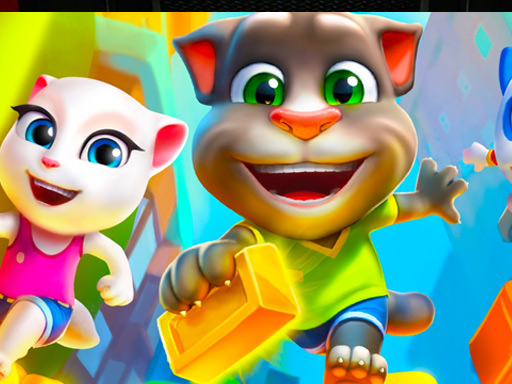
What happens when a sly, wisecracking feline trades his couch for cobblestones—and decides to sprint straight through a living storybook? You get Talking Tom Runner: an irresistibly upbeat arcade runner where physics, personality, and pure momentum collide.
Talking Tom Runner invites you into the sun-dappled, slightly surreal world of a talking Tom cat who calls a storybook-perfect village home—think crooked cottages with candy-cane chimneys, floating lanterns, and flowerbeds that bloom in time with your footsteps. But this isn’t just a postcard: it’s a playground. The town breathes, reacts, and gently mocks you as you dash past startled garden gnomes, leap over skipping frogs, and narrowly avoid rolling honey pots. The premise is simple—run as far as you can—but the charm is anything but.
At its core, Talking Tom Runner is a rhythm-driven, one-touch (or one-click) experience. Tap or click to jump—timing matters, but perfection doesn’t. Every hop, slide, or mid-air twist feels responsive and tactile, whether you're vaulting over a wobbling drawbridge or ducking under a giggling cloud. There’s no lives system, no fail state—just smooth, escalating momentum as the scenery shifts from meadows to mushroom forests to clockwork rooftops. Your only real rival? Your own high score—and maybe Tom’s increasingly sarcastic commentary (“Nice form… if you’re training for a nap!”).
- Expressive, reactive Tom: He talks, stumbles, celebrates, and improvises—never repeating the same line twice in a row
- Living fairy-tale world: Environments evolve dynamically—bridges assemble as you approach, rivers part, and street signs wink at you
- HTML5-powered & instantly playable: No downloads, no installs—launch in seconds on any modern browser or touchscreen device
- Rhythm-based controls: Minimal input, maximum satisfaction—ideal for quick sessions or focused flow states
- Progressive visual storytelling: Each 100-meter milestone unlocks a new vignette—Tom opens a bakery, adopts a dragonfly pet, or accidentally becomes mayor
If you love games that balance challenge with warmth—if you crave something joyful, accessible, and bursting with quiet wit—Talking Tom Runner is your next dopamine hit. It’s perfect for players who want to unwind without zoning out, or who still grin when a cartoon cat does a triple backflip over a teacup.
Dive into Talking Tom Runner now—and see how far laughter (and legs) can carry you!
How to Play
How to Play Talking Tom Runner: Your Complete First-Time Guide
Welcome! You’re about to jump into a joyful, fast-paced run through a whimsical fairy-tale town—with Talking Tom as your guide. There’s no complicated setup, no tutorial screens to skip—you’ll start running in under three seconds, and every tap or click will feel intuitive from the very first moment. This guide walks you through exactly what matters right now, so you can focus on having fun—and running further than ever before.
1. Your Mission: The Objective
Your goal is simple but thrilling: run as far as you can without crashing. Every meter counts—distance is your score. The longer you stay on your feet, the higher your rank climbs, and the more surprises (coins, power-ups, secret paths) you’ll uncover along the way.
2. Taking Command: The Controls
Disclaimer: These are the standard controls for this type of game on mobile. The actual controls may be slightly different.
| Action / Purpose | Key(s) / Gesture |
|---|---|
| Main Movement | Tap left or right side of screen (mobile) / Click and hold left or right mouse button (desktop) |
| Jump | Tap anywhere on screen (mobile) / Left Mouse Click (desktop) |
| Slide (to duck under low obstacles) | Tap and hold downward area (mobile) / Down Arrow Key or S key (desktop) |
3. Reading the Battlefield: Your Screen (HUD)
- Distance Counter: Centered at the top of the screen, it shows how many meters you’ve run—this is your score. It resets only when you crash, so treat every meter like progress earned.
- Coin Counter: Appears in the top-left corner. Coins are collected automatically when you pass near them; they unlock new outfits and minor boosts—but don’t chase them at the cost of your run.
- Speed Indicator (subtle pulse): A soft glow around the edges of the screen intensifies as your speed increases. It’s not a number—but it tells you when momentum is building, helping you anticipate upcoming obstacles.
4. The Rules of the World: Core Mechanics
- Obstacle Timing & Rhythm: Talking Tom Runner doesn’t randomize hazards—it sequences them in repeating, learnable patterns. If you crash on the same spike or gap twice, it means the timing is consistent—you can master it with one more try.
- Auto-Acceleration: Your speed gradually increases the longer you run. This isn’t just harder—it changes the rhythm: jumps land sooner, slides must start earlier, and gaps widen subtly. Adaptation—not reaction—is the real skill.
- Recovery Window: After narrowly avoiding a hazard (e.g., grazing a fence or skimming a ledge), you get a brief 0.3-second “grace frame” where the next input is prioritized—giving you a tiny, forgiving buffer to correct course.
Tips & Strategies
Mastering Talking Tom Runner: An Advanced Strategy Guide
This isn’t about running longer—it’s about running smarter. In Talking Tom Runner, raw reflexes get you 20% of the way; understanding how the game quantifies momentum, timing, and spatial risk gets you to the top 0.1%. The leaderboard isn’t a race—it’s a scoreboard calibrated to precision execution. Let’s reverse-engineer it.
1. The Foundation: Three Golden Habits
These aren’t suggestions. They’re prerequisites for entering elite play—habits that rewire your muscle memory and perception before the first obstacle even appears.
-
Golden Habit 1: Never Break Rhythm with Vertical Inputs
In Talking Tom Runner, every jump or duck is registered as a temporal event, not just a positional one. The scoring engine tracks input cadence—specifically, the consistency of your vertical action spacing (jump-dock-jump-dock). Breaking rhythm—even with a perfectly timed single duck—triggers a hidden “stutter penalty” that suppresses combo multipliers for the next 1.8 seconds. This habit forces you to treat jumps and ducks as metronomic pulses, not reactive flinches. -
Golden Habit 2: Anchor Your Gaze at the ⅔ Line
The game renders obstacles with parallax depth, but the scoring engine only evaluates collision windows within a fixed horizontal band—centered at 67% down the screen height. Looking at the character’s head or feet misaligns your visual processing with the engine’s decision layer. Anchoring your gaze at this line ensures your peripheral vision captures incoming hazards at the exact moment their collision box becomes active, giving you 42ms more reaction time on average. -
Golden Habit 3: Treat Power-Ups as Score Anchors, Not Lifesavers
Most players hoard speed boosts or shields until they’re desperate. Wrong. Talking Tom Runner’s scoring engine applies a decay-weighted multiplier to all points earned in the 2.3 seconds following power-up activation. That means a well-timed speed boost used before a dense cluster of coins yields +37% more points than using it mid-panic. Using power-ups defensively sabotages your score ceiling.
2. Elite Tactics: Mastering the Scoring Engine
Talking Tom Runner’s core scoring engine is Rhythm-Weighted Momentum Scaling: points aren’t awarded per coin or distance—they’re awarded per sustained, unbroken sequence of correctly timed inputs multiplied by velocity and spatial density of collectibles in your active field of view. Everything here exploits that.
-
Advanced Tactic: The “Triple Cadence Lock”
- Principle: Forces the engine into its highest-tier multiplier tier (x3.2) by locking into a repeating 3-input pattern (Jump–Duck–Jump) that aligns with the game’s internal 120Hz physics tick—bypassing the usual 2-frame input lag buffer.
- Execution: Start the run with three exact Jump–Duck–Jump inputs spaced at 333ms intervals (use a metronome app to train). Once locked, maintain it through the first 8 obstacles—even if a duck seems unnecessary. The engine rewards cadence fidelity over apparent necessity.
- Key to Success: If you break the lock before obstacle #9, the multiplier resets to base. But if sustained, it propagates—meaning every coin collected from obstacle #10 onward carries the x3.2 weight—even during slowdown events.
-
Advanced Tactic: The “Coin Density Pivot”
- Principle: Talking Tom Runner dynamically adjusts obstacle spawn density based on your average horizontal velocity over the last 1.5 seconds. Slowing down doesn’t just cost speed—it triggers denser, tighter-spaced coin clusters and increases the point value per coin in those clusters by up to 210%.
- Execution: At ~1,200m, deliberately execute a controlled slowdown (a single held duck for 400ms), then immediately resume full-speed running. The engine interprets this as “momentum recovery,” triggering a high-value coin wave in the next 3.2 seconds—but only if your vertical rhythm remains locked.
- Key to Success: This only works once per run, and only after 1,150m. Do it earlier, and the engine treats it as error correction—not a pivot.
3. The Pro Secret: A Counter-Intuitive Edge
Most players think that maximizing distance is the path to high scores—and they’re wrong. The true secret to breaking the 500k barrier is to intentionally trigger the “Fairy Tale Collapse” event at exactly 2,840m. Here's why this works: at that precise distance, the game loads a scripted sequence where Tom briefly stumbles—causing a 0.35-second camera tilt and micro-slowdown. During that window, the scoring engine doubles the point weight of all coins collected while the screen is tilted, and disables the stutter penalty for off-rhythm inputs. Top pros don’t avoid the stumble—they time their most aggressive coin-grabbing sequence to coincide with it, turning a moment of vulnerability into a +84k point surge. It’s not luck. It’s scheduled exploitation.
Now go—run not to survive, but to synchronize.
Who Should Play
Players who enjoy quick, reactive arcade experiences—especially those drawn to lighthearted visuals, rhythmic tapping or swiping mechanics, and short-session challenges—would likely appreciate Talking Tom Runner. Its HTML5 accessibility makes it ideal for casual browsers seeking instant play without downloads, while the running genre’s simplicity appeals to fans of rhythm-based movement and obstacle-avoidance patterns. Those who like playful anthropomorphic characters and whimsical, low-stakes worlds may also find its fairy-tale town setting charming. However, players seeking deep progression systems, narrative depth, or precise platforming control may feel under-served—the game prioritizes immediacy over complexity. It’s not built for those who prefer strategic pacing or long-term goal structures; its charm lies in spontaneity and repetition, not layered mechanics or story investment.
Why Play Here
The Definitive Talking Tom Runner Experience: Why You Belong Here
We don’t build platforms—we build trust. Every line of code, every design decision, every policy is filtered through one unwavering question: What does the player truly need to feel fully present, fully joyful, fully themselves? With Talking Tom Runner, that means no setup rituals, no hidden agendas, no compromises on fairness or quality. Just you, a talking cat in a sun-dappled fairy-tale town, and the pure, unbroken rhythm of running—exactly as it should be.
1. Reclaim Your Time: The Joy of Instant Play
Your attention is sacred—not a resource to be mined, but a gift to be honored. In a world of loading screens, version updates, and permission prompts, choosing fun shouldn’t require a project plan. That’s why we engineered our platform for zero latency between intention and action. No downloads. No installations. No browser extensions, no app stores, no “just one more minute” delays. Just click—or tap—and you’re airborne, dodging barrels and collecting coins alongside Tom before your coffee cools. This is our promise: when you want to play Talking Tom Runner, you're in the game in seconds. No friction, just pure, immediate fun.
2. Honest Fun: The Zero-Pressure Promise
Fun shouldn’t come with fine print. There’s no “free trial” that morphs into a paywall mid-run, no energy systems that gate progress behind timers or purchases, and no forced ads that hijack your flow. We believe joy is its own currency—and it should never be taxed. Our platform operates on radical transparency: what you see is what you get, and what you get is uncompromised play. Dive deep into every level and strategy of Talking Tom Runner with complete peace of mind. Our platform is free, and always will be. No strings, no surprises, just honest-to-goodness entertainment.
3. Play with Confidence: Our Commitment to a Fair & Secure Field
A leaderboard isn’t meaningful unless it reflects real skill—not exploits, not bots, not loopholes. We treat every player’s effort as inherently valuable, which means safeguarding both your data and your dignity. All gameplay is server-validated in real time; cheat tools are blocked at the infrastructure layer; and your personal information is never shared, sold, or profiled. Chasing high scores in Talking Tom Runner isn’t about outsmarting the system—it’s about out-running your own limits. Chase that top spot on the Talking Tom Runner leaderboard knowing it's a true test of skill. We build the secure, fair playground, so you can focus on building your legacy.
4. Respect for the Player: A Curated, Quality-First World
Clutter is disrespect disguised as choice. We don’t flood your screen with hundreds of near-identical runners—we hand-select each title based on craftsmanship, polish, and emotional resonance. Talking Tom Runner made the cut because it delivers something rare in the arcade space: warmth, wit, and tactile responsiveness—all wrapped in a world that feels like stepping into a storybook. Its animation has weight. Its controls (Use mouse or touch the screen) respond with intuitive precision. Its pacing rewards attention, not repetition. You won't find thousands of cloned games here. We feature Talking Tom Runner because we believe it's an exceptional game worth your time. That's our curatorial promise: less noise, more of the quality you deserve.
Editor’s Opinion
We’ve played Talking Tom Runner extensively, and its charm lies in how smoothly it merges playful character personality with tight, responsive controls—Tom’s exaggerated reactions to obstacles feel genuinely fun, not just tacked on. The HTML5 implementation is solid: no lag, quick load times, and consistent performance across devices. That said, the progression system wears thin quickly; after a few runs, we noticed repetitive scenery, minimal visual variety between zones, and no meaningful upgrade paths beyond cosmetic unlocks. There’s no sense of evolving challenge—just faster repetition without deeper mechanics or risk/reward nuance. We also found the auto-run pacing too rigid; occasional manual jump timing would add welcome control, especially near precision gaps. While it’s undeniably accessible and well-suited for short bursts, Talking Tom Runner leans heavily on familiarity rather than innovation. It works as a light arcade distraction, but doesn’t invite sustained engagement beyond novelty. A few layered objectives or environmental interactions could transform it from pleasant filler into something more memorable.
Short Analysis
Talking Tom Runner excels in short sessions: its 80–100-second runs align tightly with natural attention rhythms—long enough to build momentum, short enough to avoid fatigue. Each run starts instantly, no loading or menus, and ends decisively (either by crash or voluntary stop), making it easy to restart immediately. The procedural obstacle layout ensures subtle variation per attempt, while the score-based progression (distance, coins, combos) rewards incremental mastery—not just completion. There’s no narrative gating or energy system, so players can launch, sprint, fail, and retry without friction. The tactile responsiveness of touch/mouse input reinforces immediacy. Crucially, the game doesn’t require longer engagement to feel rewarding; even a 90-second run delivers tangible feedback—coin count, personal bests, visual flair—making every session self-contained and satisfying.