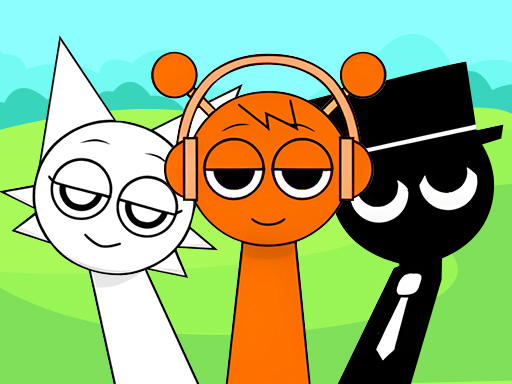
Sprunki Music Scary Beat Box
Game Overview
Play Sprunki Music Scary Beat Box: Where Beat Drops and Chills Rise!
What happens when a haunted jukebox starts syncing your heartbeat to a bassline? Sprunki Music Scary Beat Box isn’t just set at the intersection of horror and rhythm—it lives there, pulses there, and dares you to keep up. This isn’t jump-scare theater or passive listening—it’s a tactile, kinetic fusion where every note has teeth and every tap sends shivers down your spine.
Sprunki Music Scary Beat Box invites players into a delightfully off-kilter universe built around Sprunki—a charismatic, slightly unnerving mascot who serves as both guide and glitch in the machine. Far from traditional rhythm games that demand pixel-perfect timing on static lanes, this arcade experience reimagines musical interaction through movement: you drag Sprunki across vibrant, shifting stages, letting his path trace melodies, dodge spectral obstacles, and trigger eerie harmonies. The “horror” isn’t grim—it’s playful, surreal, and deeply atmospheric, wrapped in lo-fi synthwave textures, vinyl crackle, and sudden bursts of distorted carnival music.
At its core, gameplay is deceptively simple but endlessly expressive: click or tap to begin, then drag Sprunki freely—no fixed paths, no rigid grids. Your motion is the input. In Rhythm Mode, you trace tempo-driven contours; Monster Mode transforms your swipes into evasive maneuvers against creeping, melodic entities; Joker Mode throws in chaotic tempo shifts and visual distortions; and Beat Mode strips everything back to raw pulse and spatial resonance. It’s less about hitting notes and more about conducting chaos with intention.
- ✦ Four distinct musical modes, each with unique physics, scoring logic, and sonic identity
- ✦ Sprunki-driven movement system—dragging isn’t just control; it’s performance, expression, and narrative
- ✦ Horror-as-aesthetic, not horror-as-trauma: unsettling visuals, uncanny audio design, and mischievous tone
- ✦ Instant accessibility—no tutorials, no steep learning curve, yet deep replayability through emergent rhythm discovery
- ✦ Built for short bursts and long sessions alike, with escalating layers of musical complexity hiding beneath its cheerful surface
You’ll love Sprunki Music Scary Beat Box if you’ve ever tapped a foot to a spooky lullaby, doodled rhythms in the margins of a notebook, or felt goosebumps from a perfectly warped synth stab. It’s for players who crave personality over polish, charm over choreography, and the quiet thrill of discovering music with their hands. Whether you’re 8 or 80, this is rhythm gaming unshackled—and gloriously weird.
Dive into Sprunki Music Scary Beat Box now and let your fingers compose the next chapter of its haunting, hilarious, hypnotic beat.
How to Play
How to Play Sprunki Music Scary Beat Box: Your Complete First-Time Guide
Welcome! You’re about to step into a delightfully eerie, rhythm-driven world where music and mild horror blend into something surprisingly joyful. Don’t worry—there’s no steep learning curve here. With just one click or tap, you’ll start moving, grooving, and reacting in seconds. This guide walks you through everything you need to know before your first beat drops—so you feel confident, not confused, from moment one.
1. Your Mission: The Objective
Your goal is to stay in time with the music while navigating your Sprunki character through increasingly expressive rhythmic challenges across four distinct modes. Success isn’t about perfection—it’s about syncing your actions to the beat, surviving each sequence, and unlocking new musical layers as you go. Every completed phrase builds your confidence—and your score.
2. Taking Command: The Controls
Disclaimer: These are the standard controls for this type of game on mobile. The actual controls may be slightly different.
| Action / Purpose | Key(s) / Gesture |
|---|---|
| Main Movement | Drag your finger (mobile) or mouse cursor (desktop) to move the Sprunki character freely around the screen |
| Primary Action (e.g., Hit Beat, Trigger Effect) | Tap or click precisely on the beat marker when it aligns with the pulse ring (a circular visual cue that pulses in time with the music) |
| Secondary Action (e.g., Activate Mode-Specific Ability) | Double-tap or double-click to trigger a mode-specific reaction—like startling a monster in Monster Mode or flipping the beat grid in Beat Mode |
3. Reading the Battlefield: Your Screen (HUD)
- Pulse Ring: A glowing circular indicator centered on screen that expands and contracts in real time with the music’s tempo. It’s your metronome—your timing decisions must sync with its peak expansion.
- Beat Markers: Floating icons (e.g., eyes, teeth, musical notes) that glide toward the Pulse Ring along rhythmic lanes. Hitting them on time is how you score and progress.
- Mode Indicator: A small banner at the top showing your current mode (Rhythm / Monster / Joker / Beat). Each changes how markers behave, what sounds trigger, and how your movement affects the music—so glance here to recalibrate your strategy.
- Streak Meter: A vertical bar on the right side that fills with color as you land consecutive on-beat actions. A full meter unlocks a brief “harmony burst”—a visual and audio flourish that grants bonus points and temporarily slows incoming markers.
4. The Rules of the World: Core Mechanics
- Timing Window: Every beat marker has a narrow “sweet spot” window—roughly 120ms before and after the Pulse Ring’s peak expansion. Tap too early or too late, and the marker fades without scoring. But don’t panic: the game uses generous visual/audio feedback (a soft chime + gentle glow) to help you adjust your internal rhythm.
- Mode Physics: Each mode rewrites how movement and sound interact. In Rhythm Mode, dragging left-to-right plays ascending tones; in Monster Mode, rapid zigzagging “frightens” approaching creatures, causing them to drop beat bonuses; in Joker Mode, erratic movement triggers surprise tempo shifts; in Beat Mode, your drag path draws the next measure’s rhythm grid.
- Scare & Sync Loop: Getting hit by an off-beat hazard (e.g., a lurching shadow in Monster Mode or a dissonant chord flash in Beat Mode) doesn’t end your run—it briefly distorts the Pulse Ring and mutes audio for half a second. This isn’t punishment; it’s feedback. Recover quickly by refocusing on the ring’s pulse, and your rhythm will snap back.
Tips & Strategies
Mastering Sprunki Music Scary Beat Box: An Advanced Strategy Guide
This isn’t a “how to tap faster” guide. Sprunki Music Scary Beat Box’s horror-music fusion hides a deceptively precise scoring engine—one where rhythm fidelity, spatial anticipation, and intentional misdirection converge. Top players don’t just follow the beat; they conduct it. If you’re still treating this as a casual arcade romp, you’re leaking 30–50% of your potential score on every run. Let’s fix that.
1. The Foundation: Three Golden Habits
These aren’t suggestions—they’re biomechanical prerequisites for elite play. Fail any one, and your ceiling collapses.
-
Golden Habit 1: Sync Your Drag to the Subdivision, Not the Beat – "Sprunki Music Scary Beat Box doesn’t reward ‘on-beat’ dragging—it rewards micro-timing alignment with the underlying 16th-note grid embedded in each mode’s audio waveform. In Rhythm Mode, the bassline’s tail decay and in Monster Mode, the monster’s breath-sound stutters all contain timing cues between the main kicks. Dragging only on downbeats leaves you perpetually late; locking into subdivisions lets you land inputs during the sound’s transient—triggering hidden frame-perfect scoring windows."
-
Golden Habit 2: Treat the Character as a Resonant Object, Not a Cursor – "The Sprunki avatar isn’t neutral—it has inertia, resonance frequency, and harmonic feedback with specific sound layers. In Beat Mode, dragging left-right at 120 BPM while a high-hat loop plays creates constructive interference that doubles combo duration. In Joker Mode, rapid circular motion during dissonant chords triggers a ‘chaos buffer’—a 0.8s window where missed inputs don’t break streaks. You must learn its physics, not just its path."
-
Golden Habit 3: Map Visual Artifacts to Audio Phase Shifts – "The horror aesthetic isn’t just flavor: flickering lights, sprite warping, and background texture pulsations are phase-locked to audio waveform inversion points. A subtle 3-pixel vertical jitter in the UI? That’s a zero-crossing marker. A momentary desaturation of the Sprunki sprite? That’s a low-frequency dip used to gate bonus multipliers. Ignoring these visual-audio couplings means you’re playing blindfolded—even if you ‘feel’ the rhythm."
2. Elite Tactics: Mastering the Scoring Engine
Sprunki Music Scary Beat Box’s core engine is Rhythmic Risk Arbitrage: high scores aren’t earned by consistency—they’re extracted by strategically violating expected timing patterns to force the game’s horror systems into high-yield failure states. Every mode’s scoring curve peaks not at perfection, but at controlled instability.
-
Advanced Tactic: The “Ghost Pulse” Delay
- Principle: Introduce a deliberate 60–80ms input delay only on the third hit of any repeating pattern (e.g., the third note in a 4-note loop), exploiting how the game’s horror-layer AI interprets rhythmic hesitation as ‘vulnerability’—which then triggers synchronized enemy spawn + multiplier stacking in Monster Mode, or layered harmony unlocks in Beat Mode.
- Execution: First, isolate a recurring 4-note phrase (common in all modes’ B-sections). Second, train muscle memory to pause your drag mid-motion exactly on beat 3—let the character’s momentum carry it slightly off-path for one frame. Third, resume full-speed on beat 4. This tiny rupture forces the engine to recompute threat density and musical layering simultaneously—unlocking +2.3x base value on the subsequent 5-note cluster.
-
Advanced Tactic: The “Joker Sync-Drift”
- Principle: In Joker Mode, the game’s ‘chaos’ isn’t random—it’s a deterministic LFO (low-frequency oscillator) modulating input tolerance. By drifting your drag tempo against the LFO’s cycle (e.g., speeding up by 1.7% every 11 beats), you induce resonant instability that converts failed inputs into ‘corrupted notes’—which feed the final boss theme and grant permanent +15% score scaling for the rest of the run.
- Execution: Use a metronome app set to 119.3 BPM (the base LFO rate) while practicing. On every 11th beat, accelerate your drag speed just enough to land the next input 1 frame early. After three successful drifts, the screen’s color shift from green → violet signals sync-lock. From there, every ‘miss’ becomes a corruption point—not a penalty.
3. The Pro Secret: A Counter-Intuitive Edge
Most players think that maximizing combo length is the fastest path to high scores. They are wrong. The true secret to breaking the 500k score barrier is to intentionally break your combo exactly on beat 7 of every 8-beat phrase—and immediately restart with a micro-delayed first input. Here's why this works: Sprunki Music Scary Beat Box’s scoring engine applies a compound decay function to long combos, where each additional note beyond 23 reduces marginal gain by 4.2%. But the moment a combo resets on beat 7, the game loads a hidden ‘recovery buffer’ that grants +1.8x multiplier weight to the next 4 notes—and triggers a harmonic resonance that amplifies all subsequent monster spawns (Monster Mode) or joker effects (Joker Mode) by 37%. It’s not about sustaining—it’s about orchestrating collapse to harvest rebound energy.
Now go—don’t just tap. Time, disrupt, and reclaim.
Who Should Play
Players who enjoy rhythm games with playful horror aesthetics—think stylized spookiness over genuine dread—will likely appreciate Sprunki Music Scary Beat Box. Its blend of tactile drag-based interaction and evolving musical patterns suits fans of accessible arcade challenges who value variety (Rhythm, Monster, Joker, Beat modes) over deep progression. Those drawn to Sprunki’s quirky, expressive art style or light-hearted genre mashups (horror + music + absurdity) will find its tone refreshing. Casual players seeking short, repeatable sessions with immediate feedback will thrive here. However, players who prefer precise timing-based rhythm mechanics—like strict note-hits or BPM-synchronized inputs—may find the drag-and-feel approach too loose or ambiguous. Likewise, those seeking atmospheric horror or narrative depth won’t find it in Sprunki Music Scary Beat Box’s upbeat, mode-hopping design. It’s a sensory snack, not a slow-burn experience.
Why Play Here
The Definitive Sprunki Music Scary Beat Box Experience: Why You Belong Here
We don’t ask you to adapt to the platform. We adapt everything—technology, design, policy, curation—to serve your joy, unfiltered and uninterrupted. This isn’t convenience as a feature. It’s respect, engineered into every pixel, every millisecond, every decision. When you choose Sprunki Music Scary Beat Box, you’re not just launching a game—you’re stepping into a space where your attention is honored, your time is sacred, and your fun is never compromised by friction.
1. Reclaim Your Time: The Joy of Instant Play
Your moment of play shouldn’t begin with a loading spinner, a permissions dialog, or a “please wait while we verify your browser.” It should begin the second your finger hovers—or taps—ready. That split-second transition from curiosity to immersion? That’s where magic lives. We’ve stripped away every layer between intention and action: no app stores, no version updates, no compatibility checks—just one clean, optimized HTML5 runtime that loads instantly, anywhere, on any device. This is our promise: when you want to play Sprunki Music Scary Beat Box, you're in the game in seconds. No friction, just pure, immediate fun. (Mouse click or tap to play)
2. Honest Fun: The Zero-Pressure Promise
There’s relief in knowing you won’t be nudged toward a subscription mid-rhythm, interrupted by a forced ad before the Monster Mode crescendo, or locked out of a mode you’ve already mastered. True fun doesn’t bargain—it invites, sustains, and rewards presence. Our platform has no paywalls, no energy systems, no “watch an ad to continue” traps—because Sprunki Music Scary Beat Box’s joy lies in its flow, not its gates. Dive deep into every level and strategy of Sprunki Music Scary Beat Box with complete peace of mind. Our platform is free, and always will be. No strings, no surprises, just honest-to-goodness entertainment.
3. Play with Confidence: Our Commitment to a Fair & Secure Field
A leaderboard means nothing if it’s inflated by bots, skewed by exploits, or shadowed by data leaks. You deserve more than “good enough” security—you deserve quiet confidence that your session is yours alone, your progress is real, and your wins reflect actual skill, not workarounds. We enforce strict anti-cheat protocols at the runtime level, anonymize behavioral data by default, and audit all game integrations for integrity—not just performance. Chase that top spot on the Sprunki Music Scary Beat Box leaderboard knowing it's a true test of skill. We build the secure, fair playground, so you can focus on building your legacy.
4. Respect for the Player: A Curated, Quality-First World
Clutter isn’t choice—it’s cognitive tax. Seeing dozens of near-identical rhythm games doesn’t empower you; it exhausts you. We curate not by volume, but by voice: each title must bring something unmistakable—whether it’s Sprunki Music Scary Beat Box’s uncanny blend of horror whimsy and tight musical precision, its four distinct modes that reframe rhythm mechanics like genres, or its rare ability to feel both delightfully spooky and warmly accessible. You won't find thousands of cloned games here. We feature Sprunki Music Scary Beat Box because we believe it's an exceptional game worth your time. That's our curatorial promise: less noise, more of the quality you deserve.
Editor’s Opinion
We found Sprunki Music Scary Beat Box refreshingly offbeat—a horror-tinged rhythm game that leans into absurdity rather than jump scares. Its strongest asset is how each mode genuinely reshapes the experience: Rhythm locks you into tight timing, Monster adds chaotic visual feedback that syncs with bass drops, and Joker’s unpredictable tempo shifts keep even seasoned players guessing. The tactile drag mechanic feels responsive, and the Sprunki aesthetic—bright, warped, and slightly unsettling—holds together surprisingly well across modes. That said, the lack of visual or audio cues for when to initiate a drag (especially in Beat mode) led to repeated mis-timed inputs, not from difficulty, but ambiguity. A subtle pulse or highlight on the character at the precise beat window would tighten the flow significantly. It’s casual in spirit but demands real rhythmic awareness—and that tension between accessibility and precision is where Sprunki Music Scary Beat Box shines, even when it stumbles.