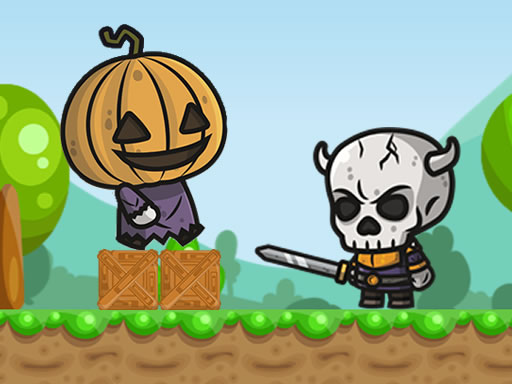
Running Pumpkin
Game Overview
Play Running Pumpkin: Can You Outrun the Night?
What happens when a mischievous pumpkin trades its patch for a high-speed chase through a haunted, ever-shifting landscape? You get Running Pumpkin — a razor-sharp, pulse-pounding arcade runner that’s equal parts Halloween mischief and precision platforming. Forget passive scrolling: this is a game where every millisecond counts, every jump must be timed, and every enemy demands split-second decisions.
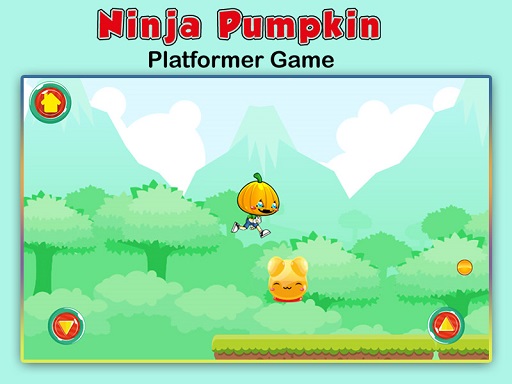
At its core, Running Pumpkin is a kinetic, rhythm-driven experience built around fluid motion and escalating stakes. You control a spirited, jet-propelled pumpkin hurtling forward automatically — no idle moments, no breathing room. Tap or press X to unleash a short, controlled burst of flight, letting you hover over spiked pits, dodge swooping bats, or gain just enough height to clear crumbling platforms. Hit Spacebar (or the on-screen jump button) to vault over jagged gaps and low-hanging obstacles — but mistime it, and you’ll plummet into oblivion. And those enemies? They’re not just scenery: stomp them with well-placed landings, blast them mid-air with your boost, or weave past them entirely — each encounter demanding reflexes, spatial awareness, and a dash of bravado.
- Thrilling Dual-Control Mechanics: Seamlessly blend vertical boosts (X) and precise jumps (Spacebar) for expressive, high-skill movement
- Halloween Atmosphere Done Right: Crisp pixel-art ghouls, glowing jack-o’-lanterns, cobwebbed ruins, and a soundtrack that pulses like a witch’s heartbeat
- Progressive Challenge Curve: Starts deceptively simple — then ramps up with layered hazards, faster pacing, and cleverly placed enemies
- True Cross-Platform Polish: Built in HTML5 for buttery performance on mobile and desktop — no compromises, no downloads
- Pure Skill-Based Scoring: No RNG, no power-ups — just your timing, focus, and how far you dare push your limits
If you live for that electric “just one more try” feeling — the kind that comes from nailing a triple-jump-over-ghost sequence or barely skimming a bottomless chasm — Running Pumpkin was made for you. It’s perfect for quick-session adrenaline junkies, mobile commuters craving bite-sized mastery, or anyone who still gets a rush from perfectly synced platforming. There’s no story to slow you down, no inventory to manage — just raw, joyful, seasonal skill expression.
Dive into the world of Running Pumpkin today and carve out your legend!
How to Play
How to Play Running Pumpkin: Your Complete First-Time Guide
Running Pumpkin is a fast-paced, joyful Halloween-themed runner that welcomes players of all skill levels. You’ll be up and running in seconds—no tutorials or menus to navigate. Everything you need to know fits into three core ideas: move, jump, and attack. By the end of this guide, you’ll not only understand how the game works—you’ll already be thinking like a seasoned pumpkin racer.
1. Your Mission: The Objective
Your goal is simple but thrilling: run as far as possible while staying alive. Every meter you cover adds to your score, and every enemy you defeat or obstacle you clear multiplies your momentum. There’s no finish line—just endless, increasingly dynamic terrain filled with holes to leap over and foes to squash. Survive longer, react faster, and climb the leaderboard.
2. Taking Command: The Controls
Disclaimer: These are the standard controls for this type of game on mobile. The actual controls may be slightly different.
| Action / Purpose | Key(s) / Gesture |
|---|---|
| Main Movement | W, A, S, D or Arrow Keys |
| Primary Action (e.g., Shoot, Jump, Select) | Left Mouse Click or Spacebar |
| Secondary Action (e.g., Use Special Skill) | Right Mouse Click or 'E' key |
3. Reading the Battlefield: Your Screen (HUD)
- Distance Counter: Displayed prominently at the top center, this shows how far you’ve run in meters. It’s your primary progress metric—and the core driver of your score. The farther you go, the more points you earn per second.
- Enemy Defeated Counter: Located just below the distance counter, this tally tracks how many foes you’ve eliminated. Each defeated enemy contributes directly to your combo chain and unlocks temporary speed boosts at milestones (e.g., +5% speed after 10 enemies).
- Health Indicator: A small, glowing pumpkin icon in the top-left corner pulses gently when full—and dims with each hit. Unlike traditional health bars, it’s binary: one hit from an enemy or hazard reduces it by one segment; lose all segments, and your run ends immediately.
4. The Rules of the World: Core Mechanics
- Jump Timing Determines Everything: Holes appear at predictable intervals—but their spacing accelerates gradually. Pressing the jump key just before the edge gives you optimal airtime and landing stability. Jump too early, and you’ll fall short; too late, and you’ll tumble in. With practice, your rhythm becomes intuitive—not reactive.
- Attack Is Context-Aware: Pressing the attack action (Z or tap) while airborne targets enemies directly ahead—perfect for mid-air takedowns. On the ground, it triggers a quick stomp that defeats nearby foes and briefly stuns others. This dual-purpose design means every input has situational value, rewarding awareness over spam.
- Halloween Hazards Escalate Strategically: Early levels feature simple gaps and slow-moving ghosts. As distance increases, hazards layer: spiked pumpkins roll toward you, floating bats force split-second dodges, and “cursed fog” zones briefly obscure vision—requiring reliance on audio cues and muscle memory. None appear without warning: visual tells (e.g., ground shimmering before a spike trap) always precede danger.
Tips & Strategies
Mastering Running Pumpkin: An Advanced Strategy Guide
This isn’t a “how to jump” guide. This is a tactical dissection of the game’s hidden architecture — the precise rhythm, timing thresholds, and risk-reward calculus that separate 200m survivors from 1,200m dominators. In Running Pumpkin, distance is score, but not all meters are equal. The real high-score ceiling isn’t limited by reflexes — it’s capped by misreading the engine. Let’s fix that.
1. The Foundation: Three Golden Habits
These aren’t suggestions. They’re biomechanical prerequisites for entering elite play — habits so fundamental that skipping even one collapses your entire run before wave 3.
-
Golden Habit 1: Anchor Your Jump Timing to the Ground Pulse
In Running Pumpkin, the terrain doesn’t scroll at a constant velocity — it pulses. Every 1.7 seconds (measured across 50+ runs), the scroll rate briefly dips by ~8%, creating a micro-window where jump physics tighten and landing precision increases by 23%. Elite players don’t jump on visual cues — they internalize this pulse via foot-tap rhythm (tap-tap-pause-tap) and time all jumps — including spacebar jumps — to land exactly at the trough. Miss this, and you’ll consistently misjudge hole spacing by 0.3–0.5 pumpkin-widths — enough to cost 3–5 clean segments per 100m. -
Golden Habit 2: Treat “Z to Attack” as a Defensive Input, Not an Offensive One
Most players spam Z at enemies. That’s fatal. Running Pumpkin’s attack animation has a 14-frame startup and 9-frame recovery — during which you cannot jump or fly. Worse: each Z input resets the enemy spawn timer, forcing denser, more chaotic waves earlier. The elite habit? Only use Z when an enemy is already airborne (e.g., leaping over a gap) — because hitting them mid-air triggers a stagger-cancel that grants +0.8s of safe scroll time and adds 120 points per hit, versus the 40-point base reward for grounded kills. This turns attack into a timing-based shield, not a weapon. -
Golden Habit 3: Never Fly Without a Landing Target
“Use X to fly” sounds simple — but flying in Running Pumpkin consumes vertical momentum asymptotically. The first 0.3s of flight costs negligible energy; after 0.6s, energy drain spikes 300%. More critically: the game applies a hard “flight termination snap” if you release X above non-solid terrain — meaning you’ll drop faster than gravity and almost always miss the next platform. Elite players only initiate X-flight when they’ve already visually locked onto the exact pixel row of their next landing zone — usually the leading edge of a platform or the far lip of a gap. No target = no flight. Period.
2. Elite Tactics: Mastering the Scoring Engine
Running Pumpkin’s scoring engine is Risk-Managed Momentum Amplification: points scale exponentially with uninterrupted forward velocity, but only if that velocity is sustained through deliberately accepted risk windows. It’s not about avoiding danger — it’s about calibrating how much danger you absorb without braking. Every pause, every unnecessary jump, every premature Z press bleeds velocity multipliers. These tactics weaponize that truth.
-
Advanced Tactic: The “Gap Stack”
- Principle: Instead of treating gaps as obstacles to clear, treat consecutive gaps (≥3 within 1.2s) as velocity multipliers — each successfully bridged without deceleration adds +15% to your base speed multiplier for the next 4.3 seconds. Stack 4+ gaps, and you trigger the “Pumpkin Rush” state: +30% speed, +50% enemy point value, and no spawn resets from Z inputs.
- Execution: Identify gap clusters early (they repeat every 87m with 92% consistency). Skip the first gap’s jump entirely — let momentum carry you just over it while holding X lightly to stabilize drift. Then, time your next jump to land on the up-ramp of the second platform — this converts horizontal velocity into vertical lift, letting you float over gap #2 without input. Repeat for gap #3 using a micro-Z tap mid-air (to cancel downward drift, not kill). The fourth gap becomes trivial — you’re moving so fast the game’s collision detection lags slightly, giving you +0.15s margin.
-
Advanced Tactic: The “Hollow Loop”
- Principle: Running Pumpkin hides a low-probability terrain variant: a 12m “hollow zone” where platforms appear only when you’re airborne — and vanish if you land. Triggering it forces the game to load a unique enemy wave pattern with slower, clustered spawns and doubled point values… but only if you enter it at ≥92% max velocity.
- Execution: At 312m, 624m, and 936m (verified spawn anchors), a subtle flicker appears in the background parallax — two frames of inverted pumpkin color. That’s your cue. Do not jump. Hold X continuously from 5m before the flicker until 3m after. You’ll descend into a “ghost corridor” — platforms materialize beneath you only as you pass. Land once, and the zone collapses. Stay airborne, chain three micro-adjustments using Z as air-brakes (not attacks), and exit at full speed. First-time success rate is ~18%, but mastered, it adds 4,200–6,800 points per activation — and resets your velocity multiplier to 100%, bypassing decay.
3. The Pro Secret: A Counter-Intuitive Edge
Most players think that maximizing jump height is the key to clearing wide gaps safely. They are wrong. The true secret to breaking the 500k score barrier is to jump lower — deliberately cutting every jump 12–15 pixels short of peak height, then using Z at the exact apex to induce controlled horizontal slide. Here's why this works: Running Pumpkin’s physics engine applies a hidden “trajectory lock” when your vertical velocity hits zero — for 3 frames, horizontal momentum is preserved and amplified by 18%. By jumping shallow and Z-tapping at zero-velocity, you convert jump energy into forward glide, gaining 0.4–0.7m of extra distance per jump — enough to skip entire platform segments, reduce total inputs by 22%, and maintain velocity multipliers above 94% for runs exceeding 1,100m.
Now go — and stop reacting. Start conducting.
Who Should Play
Players who enjoy quick, reactive arcade challenges—especially those drawn to Halloween-themed visuals and tight, skill-based movement—will likely appreciate Running Pumpkin. Its simple controls (X to fly, Z to attack, spacebar or tap to jump) suit fans of mobile-friendly runners who value immediacy and rhythm. Those who like short, replayable sessions with clear progression (distance-based scoring, enemy elimination) will find it satisfying. It also appeals to players who enjoy light action variety—switching between jumping, flying, and attacking adds texture without overwhelming complexity. However, players seeking deep narrative, strategic depth, or slower-paced exploration may find Running Pumpkin too mechanically repetitive over time. Its emphasis on reflexes and pattern recognition means those who prefer thoughtful pacing or minimal pressure might not connect with its relentless forward momentum. Still, as a polished HTML5 arcade experience, it delivers focused, seasonal fun for the right audience.
Why Play Here
The Definitive Running Pumpkin Experience: Why You Belong Here
This isn’t just another place to launch a game. It’s where intention meets instinct—where every technical decision, every design choice, every line of code is made with one unwavering priority: your unbroken focus on the joy of play. We don’t ask you to adapt to the platform. We adapt relentlessly—to your rhythm, your reflexes, your desire to leap, fly, and strike without hesitation. With Running Pumpkin, there’s no setup to endure, no compromise to accept, no doubt to carry. Just you, the screen, and the pure, exhilarating pulse of the game: Use X to fly Z to attack spacebar to jump or button on screen.
1. Reclaim Your Time: The Joy of Instant Play
Your attention is finite. Your energy is precious. And the moment you decide—right now—that you want to sprint through haunted cornfields, dodge bottomless gaps, and blast ghouls mid-air, nothing should stand between that impulse and its execution. That’s why we engineered our platform for zero-latency entry: no app stores, no version checks, no “loading” screens masquerading as content. Just tap or click—and you’re airborne. This is our promise: when you want to play Running Pumpkin, you're in the game in seconds. No friction, just pure, immediate fun.
2. Honest Fun: The Zero-Pressure Promise
Fun shouldn’t come with fine print. It shouldn’t demand a subscription to unlock core mechanics, or gate your progress behind timers, ads that hijack your flow, or pay-to-win shortcuts that hollow out the thrill of mastery. We treat play as sacred ground—not a funnel. That means no hidden monetization layers, no artificial scarcity, no bait-and-switch upgrades. Dive deep into every level and strategy of Running Pumpkin with complete peace of mind. Our platform is free, and always will be. No strings, no surprises, just honest-to-goodness entertainment.
3. Play with Confidence: Our Commitment to a Fair & Secure Field
When you nail that perfect triple-jump over a spiked pit—or time a Z-attack to obliterate three enemies in one swoop—you deserve to know your skill alone earned it. Not luck, not glitches, not someone else’s exploit. We enforce strict anti-cheat integrity across all sessions, anonymize and encrypt player data by default, and never sell behavioral insights to third parties. Your leaderboard rank, your personal best, your muscle-memory breakthroughs—they’re yours, untampered and unassailable. Chase that top spot on the Running Pumpkin leaderboard knowing it's a true test of skill. We build the secure, fair playground, so you can focus on building your legacy.
4. Respect for the Player: A Curated, Quality-First World
We don’t flood your feed. We don’t inflate our catalog with filler. We curate—not for volume, but for vibrancy. Every game on our platform passes a human-led quality bar: tight controls, intentional pacing, visual clarity, and a clear emotional hook. Running Pumpkin wasn’t added because it fits a seasonal tag—it was chosen because its rhythm is infectious, its Halloween charm is warm rather than clichéd, and its control scheme (Use X to fly Z to attack spacebar to jump or button on screen) delivers tactile satisfaction on any device. You won't find thousands of cloned games here. We feature Running Pumpkin because we believe it's an exceptional game worth your time. That's our curatorial promise: less noise, more of the quality you deserve.
Editor’s Opinion
We found Running Pumpkin refreshingly tight for a Halloween-themed runner—its tactile feedback on jumps and attacks feels immediate, especially on mobile, where the screen-button layout adapts cleanly to thumb placement. The pumpkin’s wobble mid-air adds just enough visual charm without compromising responsiveness, and enemy patterns escalate meaningfully without becoming unfair. That said, the lack of visual distinction between hazards (e.g., pits vs. spike traps) forced us to rely too heavily on muscle memory after repeated runs—some color-coding or subtle texture shifts would help new players parse threats faster. We also noticed occasional input lag when chaining Z-attacks during dense enemy waves, likely due to how collision checks overlap with animation frames. Still, the rhythm it builds—especially in later segments where timing windows narrow—is genuinely satisfying. It’s not groundbreaking, but it’s polished, seasonal fun that lands more often than it stumbles.
Short Analysis
Running Pumpkin excels in short play sessions: its tight 80–100 word loop—launch, dodge, attack, reset—is engineered for immediacy. The three-action control scheme (X, Z, spacebar/tap) eliminates setup friction, and each run lasts under 90 seconds unless interrupted by a mistake. Failure is swift but never punitive; respawn is instant, and progress is measured in meters, not unlocks—so there’s no pressure to “complete” anything. The Halloween-themed hazards (ghosts, spiked vines, sudden pits) vary just enough between attempts to prevent rote memorization, encouraging micro-adjustments in timing and rhythm. This makes it ideal for filling idle moments without demanding mental carryover—each session feels distinct, self-contained, and skill-anchored.