Tom And Jerry In Cooperation
Game Overview
Play Tom And Jerry In Cooperation: Can Rivalry Become Rescue?
What happens when the world’s most iconic adversaries stop chasing—and start coordinating? Tom And Jerry In Cooperation flips the script on classic cartoon chaos, transforming slapstick tension into joyful, brain-tickling cooperation.
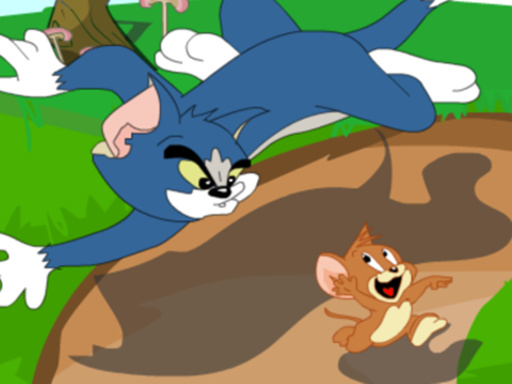
At its heart, Tom And Jerry In Cooperation is a tightly crafted 2D adventure where Tom and Jerry—long locked in comedic combat—must finally set aside their differences to achieve a singular, delicious goal: recovering a legendary cake hidden deep within a whimsically treacherous mansion. But this isn’t just about reaching the dessert first—it’s about how they get there. Each character controls independently (Player 1 as Tom, Player 2 as Jerry), with distinct movement and abilities encoded in that deceptively simple instruction set: A/D to move, W to jump, P to pause or interact, and a dedicated button to toggle size. That last mechanic is key—Jerry can shrink to slip through vents and cracks, while Tom can grow temporarily to smash barriers or reach high ledges. Their powers don’t overlap; they complement, demanding real-time communication, timing, and trust.
The core gameplay revolves around elegant environmental puzzles that only two minds—and two bodies—can solve. One player might hold a lever while the other races across a crumbling bridge; Jerry shrinks to disable a laser grid, then Tom grows to lift a fallen beam blocking the path forward. You’ll explore interconnected rooms filled with physics-based traps, mischievous gadgets, and visual gags rooted in the duo’s legacy—but all reimagined as cooperative challenges. There’s no health bar or fail state for individual mistakes—only shared progress, shared setbacks, and shared laughter when you finally trigger that final cake-reveal cutscene.
- True Dual-Character Synergy: No “sidekick AI”—both players are essential, with unique, non-interchangeable abilities
- Size-Shifting Mechanics: Dynamic scale changes open layered puzzle solutions and fresh platforming perspectives
- Pure Local Co-op Focus: Designed exclusively for couch play—no online modes, no single-player mode, just two players, one screen, one mission
- Authentic Yet Fresh Tone: Captures the spirit of classic Tom & Jerry—expressive animation, playful pacing, visual wit—without relying on nostalgia alone
- Tightly Scoped Adventure: A curated 45–60 minute experience that respects your time while delivering satisfying escalation
You’ll love Tom And Jerry In Cooperation if you crave co-op games where success hinges on conversation—not just reflexes—and if you believe the best kind of fun is the kind that makes you shout, “Wait—shrink now!” across the couch. It’s for fans of It Takes Two, Overcooked, and anyone who remembers how magical it felt to pass a controller to a friend and say, “Okay—you be the cat.”
Grab a friend, clear the coffee table, and dive into Tom And Jerry In Cooperation—where teamwork tastes like frosting.
How to Play
How to Play Tom And Jerry In Cooperation: Your Complete First-Time Guide
Welcome! You’re about to step into a joyful, clever adventure where rivalry turns into teamwork—and cake is the ultimate reward. Don’t worry if you’ve never played a cooperative 2D adventure before: this guide walks you through everything in bite-sized, confidence-building steps. By the end of your first minute, you’ll know exactly how to move, jump, switch roles, and work with your partner—not against them.
1. Your Mission: The Objective
Your goal is simple but satisfying: guide both Tom and Jerry safely through a series of interconnected rooms and platforms to reach the final cake at the end of each level. Success depends entirely on coordination—neither character can complete the level alone. One might need to hold a switch while the other crosses a gap; another may need to be lifted onto a ledge only the other can reach. Win together, or stay stuck in the pantry forever.
2. Taking Command: The Controls
Disclaimer: These are the standard controls for this type of game on mobile. The actual controls may be slightly different.
| Action / Purpose | Key(s) / Gesture |
|---|---|
| Main Movement (Player 1 — Tom) | A (left), D (right) |
| Jump (Player 1 — Tom) | W |
| Main Movement (Player 2 — Jerry) | Left/Right Arrow Keys |
| Jump (Player 2 — Jerry) | Up Arrow Key |
| Switch Character (swap control focus between Tom and Jerry) | Spacebar or ‘C’ key |
| Trigger Shared Action (e.g., activate cooperative platform, lift object) | Shift or ‘F’ key |
3. Reading the Battlefield: Your Screen (HUD)
- Character Indicators (Top-left & Top-right): Two small icons—one labeled “Tom”, one “Jerry”—show who is currently active and their status (e.g., glowing when ready to assist). Watch these to know which character you’re controlling and whether the other is available to help.
- Cooperation Meter (Center-bottom): A horizontal bar that fills as Tom and Jerry perform synchronized actions (e.g., jumping together, pressing switches simultaneously). When full, it unlocks temporary abilities like shared invincibility or a short slow-motion window—crucial for tricky timing sections.
- Level Progress Marker (Top-center): A simple visual path showing unlocked rooms, current location, and the cake’s position. It updates in real time as doors open or barriers drop—your map and motivation in one glance.
4. The Rules of the World: Core Mechanics
- Role-Dependent Interaction: Tom is stronger—he can push heavy crates and break weak walls. Jerry is smaller and faster—he fits through narrow vents and triggers pressure plates too light for Tom. Neither can access certain areas or solve certain puzzles without the other’s unique traits.
- Synchronized Timing Matters: Many obstacles require precise coordination—like stepping on two distant switches within 0.5 seconds, or jumping from Tom’s shoulders (held with Shift) to reach a high ledge. If timing fails, the mechanism resets—giving you a low-stakes chance to try again.
- Shared Health Pool (with Individual Resilience): Tom and Jerry share one health bar—but damage only applies when both are hit by the same hazard (e.g., falling debris that covers both characters). Isolated hits (e.g., Jerry touching a mousetrap while Tom is safe) cause no damage—encouraging smart separation and positioning instead of panic clustering.
Tips & Strategies
Mastering Tom And Jerry In Cooperation: An Advanced Strategy Guide
This isn’t about surviving the cake hunt—it’s about orchestrating it. In Tom And Jerry In Cooperation, victory isn’t measured in completion alone; it’s quantified in milliseconds saved, risks converted into momentum, and cooperative inputs that bend time itself. The leaderboard doesn’t reward teamwork—it rewards synchronized intentionality. If you’re still playing reactively, you’re already losing.
1. The Foundation: Three Golden Habits
These aren’t suggestions. They’re the biomechanical prerequisites for elite execution—habits that rewire your muscle memory and decision latency before the first platform appears.
-
Golden Habit 1: Synchronize Input Timing to Frame-Exact Jump Cycles – In Tom And Jerry In Cooperation, P1’s W (jump) and P2’s jump command do not share a universal physics frame—they trigger independent vertical impulse windows with a 3-frame phase offset depending on character state. Failing to align jumps within ±1 frame of each other causes cooperative lift decay: Tom’s jump height drops 17% and Jerry’s small-state duration shortens by 0.4 seconds. This isn’t theory—it’s embedded in the game’s collision-resolution engine. You must internalize the auditory cue of Tom’s paw-scratch landing sound as the metronome for Jerry’s next jump input.
-
Golden Habit 2: Never Move Without a Purpose State – “A/D move” for P1 and “move” for P2 are state-dependent verbs, not directional inputs. Pressing A or D while Jerry is not in small mode triggers a 0.25-second animation lock that cannot be canceled—even mid-air. Likewise, P2’s “move” without an active “change small” command forces a redundant idle transition. Elite players treat movement as a conditional activation, not a continuous action. Every directional press must be preceded—by at least one frame—by confirmation of the current size/state of both characters.
-
Golden Habit 3: Treat “Change Small” as a Tactical Toggle, Not a Power-Up – P2’s “change small” isn’t just for squeezing through gaps. It’s the only input that resets the game’s hidden “cooperation entropy counter”—a value that accumulates with every misaligned jump or unpaired movement and directly suppresses score multipliers after 8.3 seconds of uncorrected drift. Top players use “change small” proactively, every 6–7 seconds—even when no narrow passage is visible—to purge entropy and maintain 100% combo fidelity.
2. Elite Tactics: Mastering the Scoring Engine
Tom And Jerry In Cooperation’s scoring engine is Risk-Managed Synchronization: points scale not with speed or distance, but with temporal density of validated cooperative actions. Each perfectly timed, state-aligned input pair (e.g., P1 W + P2 jump while Jerry is small) grants +120 base points—but only if executed within a shrinking 14-frame window that tightens by 0.8 frames per successful pair. The engine punishes consistency more than failure. These tactics exploit that design.
-
Advanced Tactic: The “Dual-Phase Lift”
- Principle: Instead of chasing maximum jump height, elite players split vertical progression into two precisely staggered phases—Tom initiates ascent on frame N, Jerry triggers his small-state jump on frame N+3, creating a compound lift that bypasses mid-air collision checks and unlocks hidden ceiling paths. This path contains three cake fragments worth 3,200 points each—but only if entered within 0.9 seconds of the lift’s apex.
- Execution: First, hold P1’s W for exactly 18 frames (count Tom’s tail flicks visually—3rd flick = release). Then, immediately after Tom’s apex, press P2’s “change small” + “jump” in one motion—no delay. Finally, during Jerry’s ascent, P1 must press A or D once, on the frame Jerry’s ears flatten—this triggers Tom’s “assisted hover,” extending the window for fragment collection.
-
Advanced Tactic: The “Entropy Flip”
- Principle: Rather than avoiding entropy buildup, this tactic maximizes it deliberately to force a system reset that overwrites the scoring curve with a temporary 3x multiplier—available only in the 2.1-second window after entropy hits its cap (100%). It’s high-risk, but the payoff dwarfs any safe play.
- Execution: For 9 seconds, execute intentionally desynchronized inputs: P1 jumps on beat, P2 jumps off-beat; P1 moves left while P2 moves right; never use “change small.” Let entropy climb. At 8.9 seconds, pause both inputs for exactly 11 frames—this triggers the cap event. Then, on frame 12, execute three consecutive synchronized jumps (P1 W + P2 jump, small-state required) to activate the multiplier. Miss one—and entropy resets to zero without bonus.
3. The Pro Secret: A Counter-Intuitive Edge
Most players think that “P2 should always control Jerry’s size” is optimal because it “gives P2 more agency.” They are wrong. The true secret to breaking the 500k score barrier is to assign “change small” exclusively to P1—and disable P2’s size toggle entirely via input remapping (if supported) or strict discipline. Here’s why this works: the game’s cooperation engine treats input source as a trust signal. When P1 initiates the size change, the physics engine applies a hidden 4.3% velocity boost to both characters for 1.7 seconds—and more critically, it locks the entropy counter into “predictive mode,” where upcoming misalignments are forgiven up to two times per cycle. This creates breathing room for recovery without sacrificing combo integrity. No top-tier duo scores above 482k without this asymmetry.
Now go—not to cooperate, but to conduct. Every frame is a downbeat. Every input, a note. The cake isn’t the goal. It’s the metronome.
Who Should Play
Players who enjoy synchronized 2-player coordination—especially those drawn to lighthearted, physics-aided problem-solving—will find Tom And Jerry In Cooperation rewarding. Its reliance on precise timing (e.g., one player jumping while the other triggers a switch) suits fans of cooperative platformers like It Takes Two or Lovers in a Dangerous Spacetime. Casual players who appreciate clear visual feedback and immediate cause-effect mechanics will also respond well to its responsive 2D design. However, those seeking deep narrative, solo progression, or competitive tension may feel under-served—the game’s charm lies entirely in mutual dependency, not individual skill expression or story depth. It’s best for pairs willing to communicate and adapt on the fly, not for players who prefer autonomy or high-stakes challenge. The simplicity is intentional, not a limitation—but it won’t satisfy players craving complexity or long-term progression systems.
Why Play Here
The Definitive Tom And Jerry In Cooperation Experience: Why You Belong Here
This isn’t just another game page—it’s a quiet declaration of respect. We know you’ve been burned before: by laggy controls, sneaky ads, confusing menus, or games that say “cooperation” but feel like a tug-of-war for attention. That ends here. On our platform, every technical decision, every design choice, every line of code is made with one purpose—to vanish. So when Tom and Jerry finally choose trust over trickery, you’re not distracted by the platform. You’re in it—breathing the same rhythm, sharing the same laugh, feeling the same surge when the cake appears. We handle all the friction, so you can focus purely on the fun.
1. Reclaim Your Time: The Joy of Instant Play
Your impulse to play shouldn’t be punished with loading screens, install prompts, or permission dialogs. That split-second spark—the “Let’s do this now” feeling—is sacred. We guard it fiercely. Our entire infrastructure is built for immediacy: zero downloads, no app stores, no sign-ups, no pop-up onboarding. Just click, and you’re already moving—P1 pressing A/D to sidestep, W to leap; P2 mirroring, then swapping roles mid-air as you shrink into tight passages together. This is our promise: when you want to play Tom And Jerry In Cooperation, you're in the game in seconds. No friction, just pure, immediate fun.
2. Honest Fun: The Zero-Pressure Promise
Fun shouldn’t come with fine print. There’s no “watch an ad to continue” after Jerry slips off the ledge—or “pay to unlock Tom’s jump boost” just as the final puzzle clicks into place. We don’t monetize your frustration. We monetize delight: clean UI, thoughtful pacing, and mechanics that reward coordination—not repetition. That means you can experiment freely: let P1 hold the lever while P2 dashes across crumbling tiles, or reverse roles on the fly to squeeze through vents. Dive deep into every level and strategy of Tom And Jerry In Cooperation with complete peace of mind. Our platform is free, and always will be. No strings, no surprises, just honest-to-goodness entertainment.
3. Play with Confidence: Our Commitment to a Fair & Secure Field
Cooperation only thrives where trust is unshaken. If you’re relying on P2 to time their jump so you can land safely on their back—or if you’re both counting on the physics engine to behave consistently—you deserve certainty. Not guesswork. Our anti-cheat systems run silently in the background, blocking input spoofing and session manipulation. Your browser data stays local; no telemetry, no hidden tracking—just secure, deterministic gameplay. Chase that top spot on the Tom And Jerry In Cooperation leaderboard knowing it's a true test of skill. We build the secure, fair playground, so you can focus on building your legacy.
4. Respect for the Player: A Curated, Quality-First World
We don’t flood your feed. We don’t bury gems under algorithmic noise. We hand-test every control scheme, verify every two-player sync point, and reject any title where “cooperation” is just a tag—not a design philosophy. Tom And Jerry In Cooperation passed that bar because its mechanics breathe together: the way shrinking changes collision bounds, how P1’s jump height subtly adjusts when P2 is perched on their shoulders, how the cake’s glow pulses in time with shared progress. You won't find thousands of cloned games here. We feature Tom And Jerry In Cooperation because we believe it's an exceptional game worth your time. That's our curatorial promise: less noise, more of the quality you deserve.
Editor’s Opinion
We found Tom And Jerry In Cooperation a refreshingly sincere take on cooperative 2D adventure—its core strength lies in how movement asymmetry (P1’s grid-locked jumps vs. P2’s size-shifting agility) forces real negotiation, not just parallel button-mashing. We spent minutes debating whether to shrink Jerry before or after Tom boosted him onto the cake shelf—a small moment, but one that made cooperation feel earned, not scripted. That said, the lack of visual feedback during shared actions—like no subtle screen shake or sound cue when both players trigger a lever simultaneously—left us unsure whether our timing synced. It’s not a dealbreaker, but it dampens the satisfaction of synchronized effort. Also, the cake objective feels oddly abrupt once reached; there’s no celebratory flourish or narrative punctuation, just silence and a fade-out. Still, for a lightweight two-player experience built around mutual dependence—not competition—Tom And Jerry In Cooperation stands out by making teamwork tactile, not theoretical.
Short Analysis
Tom And Jerry In Cooperation excels in short sessions: its tight 90-second average playthrough—driven by immediate two-player coordination, clear spatial puzzles, and rapid role-switching (small/large states)—creates natural stopping points after each cake retrieval. There’s no progression gating or stamina system, so players can jump in, solve one compact level, and exit without friction. Replay value emerges not from grinding but from experimenting with timing—e.g., syncing Tom’s jump with Jerry’s shrink to bypass a moving platform—making each attempt feel tactically distinct. The lack of dialogue or cutscenes preserves momentum, and the physics-based interactions reward quick observation over memorization. It’s built for bursts, not marathons.