World of Alice Solar System
Game Overview
Play World of Alice Solar System: Where Curiosity Takes Off Into Orbit!
What if learning the solar system felt less like homework—and more like launching a rocket with your best friend? World of Alice Solar System does exactly that, transforming astronomy into an interactive, joyful discovery journey guided by Alice—a bright, encouraging companion who makes cosmic facts feel personal, playful, and profoundly memorable.
World of Alice Solar System is an elegantly designed educational puzzle game developed by Nau.kids, built for children (and curious minds of all ages) to explore our celestial neighborhood—from Mercury’s scorched surface to Neptune’s icy winds—across tablets, phones, and desktops. But this isn’t a static quiz app or a passive slideshow. It’s a living, responsive learning environment where knowledge unfolds through gentle challenge and visual delight. Alice doesn’t just narrate; she invites, questions, celebrates, and scaffolds understanding at every turn—turning abstract astronomical concepts into tangible, relatable experiences.
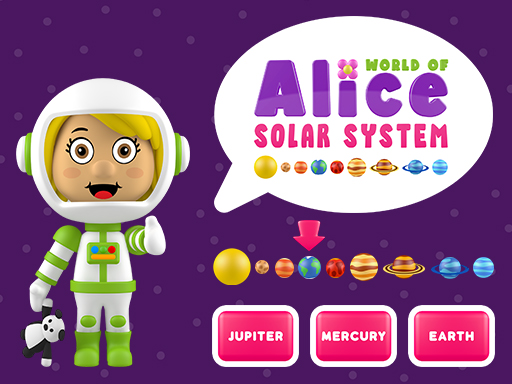
At its heart, gameplay revolves around precise, intuitive identification: a friendly arrow points to a planet or star, and players tap or click the correct name from a curated set of options. Each interaction reinforces spatial relationships, orbital order, distinguishing features (like Saturn’s rings or Venus’s thick clouds), and even basic stellar classification—all wrapped in clean, vibrant visuals and subtle audio feedback. The pacing is thoughtful: early levels focus on inner planets and familiar stars, gradually introducing dwarf planets, Kuiper Belt objects, and stellar phenomena as confidence grows. There’s no timer pressure—just calm, confident progression.
- ✅ Gentle, adaptive learning: Difficulty scales organically, supporting diverse learners without frustration
- ✅ True cross-platform play: Seamlessly switch between tablet, phone, or browser—no lost progress
- ✅ Child-centered design: Rounded UI elements, clear typography, zero ads or external links
- ✅ Science-accurate & curriculum-aligned: Concepts vetted for age-appropriate rigor (e.g., distinguishing “planet” vs. “dwarf planet”)
- ✅ Alice as co-explorer: Her warm narration and expressive animations build emotional connection to space
You’ll love World of Alice Solar System if you believe learning should spark wonder—not anxiety—if you’ve ever watched a child point skyward and ask “What’s that?” and wished you had the perfect tool to answer together. It’s for teachers seeking a trusted digital supplement, parents wanting screen time with substance, and kids who light up when they realize they can name every planet—in order.
Dive into World of Alice Solar System today—and let every tap launch a new moment of cosmic understanding.
How to Play
How to Play World of Alice Solar System: Your Complete First-Time Guide
Welcome to World of Alice Solar System! This is a gentle, joyful introduction to our solar system—designed especially for young learners. There’s no timer to rush you, no penalties for trying, and no complicated menus to navigate. In just a few seconds, you’ll be pointing, clicking, and confidently naming planets and stars alongside Alice. You’re not just playing—you’re discovering, and every correct answer is a small victory.
1. Your Mission: The Objective
Your goal is simple and satisfying: identify the planet or star pointed to by the arrow. Each round shows a clear illustration of the solar system (or a close-up of a celestial body), with one arrow highlighting a specific object. Tap or click the correct name from the set of labeled options below the image. Get it right, and you’ll advance—learning more, earning encouragement, and building confidence with every answer.
2. Taking Command: The Controls
Disclaimer: These are the standard controls for this type of game on mobile. The actual controls may be slightly different.
| Action / Purpose | Key(s) / Gesture |
|---|---|
| Select Answer | Tap (on touchscreens) or Left Mouse Click (on computers) |
| Navigate Between Questions | Automatic progression after correct answer; tap “Next” button if shown |
| Restart or Retry | Tap the circular arrow icon (usually in the top-right corner) |
3. Reading the Battlefield: Your Screen (HUD)
- Central Solar System Illustration: This is your main learning canvas—the visual reference that shows planets, the Sun, and sometimes moons or orbits. The arrow always points directly to one object here, so keep your eyes focused on this area.
- Answer Options Panel: A row or grid of clearly labeled names (e.g., “Mercury”, “Venus”, “Sun”) appears beneath the illustration. These are your only possible choices—no guessing required, just recognition and selection.
- Alice’s Feedback Indicator: A friendly animated character (Alice) appears beside your answer choice—smiling and cheering for correct answers, or gently nodding with a helpful hint if you’re unsure. Her reactions guide your understanding without judgment.
- Progress Tracker (Stars or Badges): Small icons (like stars or planetary badges) appear at the top or side as you correctly identify objects. They show how many celestial bodies you’ve learned so far—not as a score, but as a personal learning map.
4. The Rules of the World: Core Mechanics
- One Arrow, One Answer: Each screen displays exactly one arrow pointing to one celestial object. You only ever need to choose one matching name from the available options—there are no trick questions or hidden layers.
- Immediate, Positive Reinforcement: As soon as you select an answer, Alice responds instantly—naming the object aloud, displaying its key fact (e.g., “That’s Jupiter—the largest planet!”), and showing a brief animation. This reinforces memory through sound, text, and motion.
- Scaffolded Difficulty: Early rounds feature high-contrast visuals and only 2–3 answer choices (e.g., Sun, Earth, Moon). As you progress, the number of options increases and images include more subtle details (e.g., distinguishing Saturn’s rings from Uranus’s tilt), always staying within developmental readiness for ages 5–10.
Who Should Play
Players who enjoy light, goal-oriented puzzles with clear visual feedback—especially those drawn to space themes or early science concepts—would find World of Alice Solar System engaging. Its click-to-identify mechanic suits learners who prefer tactile, low-stakes interaction over complex rules or time pressure. Educators and parents seeking supplemental tools for astronomy basics may also appreciate its structured, distraction-free interface. However, players who favor deep strategy, narrative depth, or fast-paced challenges are likely to find it too simplistic or repetitive after brief exposure. The game’s emphasis on recognition over exploration or simulation means it won’t satisfy those looking for immersive world-building or physics-based mechanics. Its charm lies in clarity and consistency—not complexity—making it ideal for players who value calm, purposeful engagement over adrenaline or open-ended discovery.
Why Play Here
The Definitive World of Alice Solar System Experience: Why You Belong Here
This isn’t just another tab in your browser — it’s where curiosity lands softly, where learning breathes freely, and where a child’s first encounter with the solar system feels like discovery, not duty. We built our platform not around ads, algorithms, or engagement metrics — but around the quiet, profound trust that forms when a player (or parent, or teacher) knows exactly what they’ll get: clarity, care, and zero compromise on joy.
1. Reclaim Your Time: The Joy of Instant Play
Your attention is sacred. A child’s spark of wonder — the moment they point at Jupiter on screen and ask “Why is it striped?” — shouldn’t be delayed by loading bars, app store approvals, or permission prompts. That fleeting, golden window of engagement? We protect it fiercely. Our entire infrastructure is engineered for one thing: zero-latency entry. No downloads. No installations. No “please wait while we verify your device.” Just tap, click, or swipe — and you’re already orbiting Saturn with Alice. This is our promise: when you want to play World of Alice Solar System, you're in the game in seconds. No friction, just pure, immediate fun.
2. Honest Fun: The Zero-Pressure Promise
There’s no such thing as “free” if it comes with nickel-and-diming, forced waits, or pop-ups that hijack focus mid-orbit. We reject that model entirely — not as a business decision, but as an ethical one. Fun shouldn’t require negotiation. Learning shouldn’t demand subscription logic. On our platform, World of Alice Solar System unfolds exactly as its creators intended: bright, unhurried, and unburdened. Dive deep into every level and strategy of World of Alice Solar System with complete peace of mind. Our platform is free, and always will be. No strings, no surprises, just honest-to-goodness entertainment.
3. Play with Confidence: Our Commitment to a Fair & Secure Field
A child clicking on Pluto shouldn’t have to navigate intrusive ads disguised as planets. A teacher launching World of Alice Solar System in class shouldn’t worry about data leaks or third-party trackers embedded in the background. Safety here isn’t a checkbox — it’s woven into how we serve every asset, validate every session, and design every interaction. We enforce strict privacy-by-default policies, ban behavioral ad networks outright, and maintain real-time moderation of all shared elements (like classroom links or progress exports). Chase that top spot on the World of Alice Solar System leaderboard knowing it's a true test of skill. We build the secure, fair playground, so you can focus on building your legacy.
4. Respect for the Player: A Curated, Quality-First World
We don’t chase volume. We curate intention. Every game on our platform passes a dual filter: Does it honor cognitive development without condescension? Does it treat interface as invitation — not obstacle? World of Alice Solar System clears both, effortlessly. Its hand-drawn constellations, intuitive arrow-guided interactions, and gentle voice-led feedback reflect a rare alignment of pedagogy and playfulness. You won't find thousands of cloned games here. We feature World of Alice Solar System because we believe it's an exceptional game worth your time. That's our curatorial promise: less noise, more of the quality you deserve.
Editor’s Opinion
We found World of Alice Solar System a refreshingly focused puzzle experience—its clean interface and immediate feedback make planetary identification feel like play, not drill. The arrow-based targeting works well for young learners, and Alice’s gentle narration adds warmth without overwhelming. What stands out is how effectively it isolates core astronomy vocabulary: children grasp distinctions between planets, dwarf planets, and the Sun through repetition and visual consistency—not rote memorization. That said, we noticed the lack of contextual scaffolding: no brief facts (e.g., “Jupiter is the largest planet”) appear after selections, which misses a natural teaching moment. A subtle tooltip or one-sentence reinforcement would deepen retention without cluttering the design. Also, while responsive across devices, the touch targets on mobile sometimes require careful tapping—slightly larger hit areas would help smaller fingers. Still, as a targeted, low-friction intro to solar system literacy, it delivers with quiet confidence.